
Your Honor, Show Your Work
Oregon Needs Real Data on Its Judges

Oregonians pride themselves on transparency. We were early to vote-by-mail. Our public records law starts from a presumption of disclosure. We publish salaries, contracts, and agency performance dashboards. The public interest favors openness. Citizens have a right to know what their government is doing.
But in election after election, voters are tasked with determining whether to elect (or re-elect) circuit judges, Court of Appeals judges, and Supreme Court justices with almost no performance information. The Oregon State Bar’s Judicial Voting Guide offers biographies and candidate statements. Occasionally a bar association endorsement or news story rises to the public consciousness. But there is no systematic reporting on how quickly a judge moves cases, how often their decisions are reversed on appeal, or how they compare with their peers.
I first thought seriously about the information deficit in judicial elections when I was practicing in Texas, where judges are elected by political party. That seemed like a bad idea, since most local legal issues don’t have a political valence, but it offered at least some evidence of how a judge might rule. Here in Oregon, we ask voters to render a verdict on judicial performance while systematically withholding the evidence. In fact, Oregon collects detailed performance data on every judge. It just refuses to share the data with voters.

We Already Have The Data
This information vacuum is not inevitable. Oregon’s Judicial Department (OJD) already collects much of what voters actually need to evaluate performance.
Each year OJD publishes systemwide statistics. These show time to disposition by case type, clearance rates (cases closed as a percentage of cases filed), the age of pending cases, and trial metrics. In 2018 the department adopted formal time to disposition standards aligned with national models. For example, the goal is to resolve 90 percent of general civil cases within 12 months and 98 percent within 18 months.
The benchmarks exist. The data exists. What does not exist is judge-level reporting.
Right now OJD chooses to publish these numbers only in the aggregate, as the statewide average time to disposition. That is a policy choice, not a technical limitation. The same case management system can compute it by courtroom and by judge.
Oregon’s public records law should point in the opposite direction. Chapter 192 of the Oregon Revised Statutes starts from a presumption that records of public bodies, including courts, are open unless a specific exemption applies. A judge’s case processing performance is not a private personnel file or a medical chart. It is the work product of an elected constitutional officer, carried out in the name of the people of Oregon.
If we truly believe in transparency, OJD should publish annual judge-level performance reports using data it already collects, including time to disposition by case type, clearance rates, and the age of pending cases. Those reports should be posted online in a form the public, journalists, and prospective candidates can actually use. Some will point out that other jurisdictions have this data, but give judges a private midterm peak at it before publishing it at the end of their term. That’s not the Oregon Way. We believe in transparency.
Democracy requires an ongoing record of how public servants are doing their jobs, not just a glossy paragraph dropped into a Voters’ Pamphlet every six years.
What More We Should Measure
Publishing existing administrative data is the floor, not the ceiling. Oregon should also build a basic judicial performance “dashboard” around a few additional metrics that are easy to measure and hard to game.
First, timeliness of written opinions. Once a matter is argued and submitted, how long does it take a judge to issue a written ruling? Delay has real world consequences. Businesses cannot plan. Families remain in limbo. Justice delayed becomes justice denied. The American Bar Association’s model time standards emphasize that courts should set and monitor goals for resolving appeals and motions. Opinion timeliness is one of the simplest things to track from existing records.
Second, courtroom punctuality and hearing management. Chronic judicial lateness and poorly managed calendars impose direct costs on litigants, witnesses, jurors, and lawyers. Many of them are hourly workers or small practitioners who can least afford avoidable delays. Modern case management systems can log when a calendar is scheduled and when proceedings actually begin. Oregon should use that capability.
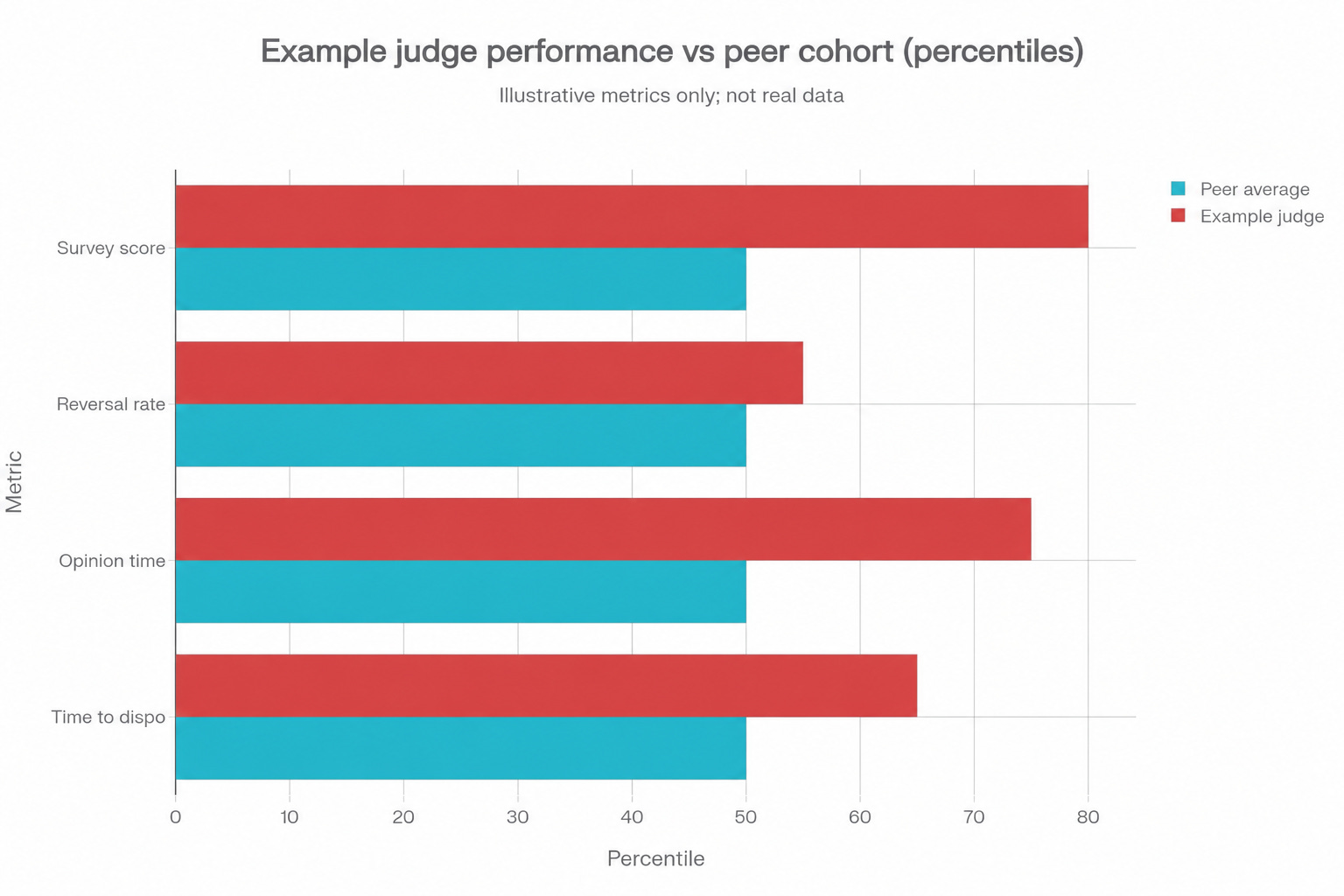
Third, reversal rates, handled carefully. When the Court of Appeals repeatedly reverses a particular judge, voters have a legitimate interest in knowing that. Alaska’s official judicial performance program publishes reversal rates for each judge in the state’s Official Election Pamphlet. In Nevada, a nonprofit called Our Nevada Judges has built a public database that tracks reversal rates for hundreds of judges.
But reversal rates are easy to misuse. A judge assigned to hard, close cases will be reversed more often than one handling routine matters. Only a tiny fraction of all decisions are appealed. A judge with three reversals out of ten reviewed decisions looks worse than one with twenty reversals out of two hundred, even though the second judge has a higher raw count. Any Oregon metric would need to normalize reversals per 100 reviewed cases, publish the denominator (how many decisions were appealed), and explain that a judge’s case mix matters.
Fourth, attorney and court user surveys. Some of the most important judicial qualities--such as preparation, impartiality, clarity in communication, and temperament--are best assessed by the people who appear in front of a judge. Most state judicial performance evaluation programs use structured surveys of attorneys, and increasingly of court users, to capture these dimensions. The Oregon State Bar already has the infrastructure to run such surveys at scale.
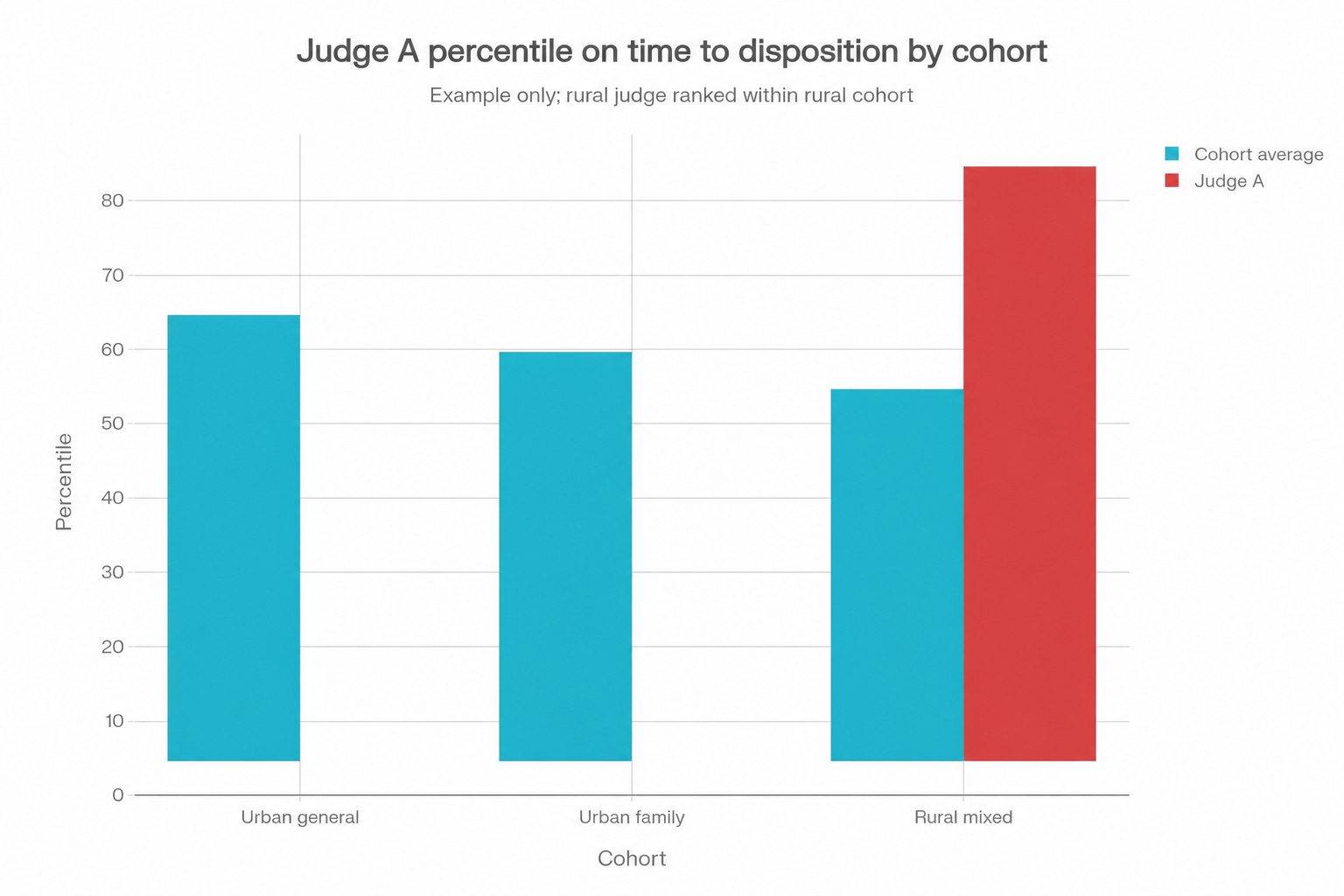
Fifth, cohort comparisons and percentile rankings. Numbers need context. Knowing that a judge takes an average of 280 days to resolve general civil cases is less useful than knowing this is slower than 80 percent of their peers. The Institute for the Advancement of the American Legal System, which has studied judicial performance programs nationwide, recommends measuring judges both against objective benchmarks and relative to other judges in comparable roles. These also help judges rebut claims from disgruntled litigants that a necessary delay in their particular case is a pattern.
“Comparable” is doing a lot of work. A rural generalist in Harney County should not be ranked against a family law specialist in Multnomah County. Oregon would need to build peer cohorts based on court level, county size, and case mix, and be willing to say “insufficient data” when caseloads are too small for a meaningful ranking. States such as Alaska and New Mexico already do this. Oregon would not be breaking new ground.
Note that none of these metrics is partisan or relies on whether the law compelled the judge to rule a particular way in a case. They appropriately tell voters how hard the judge works. And that is the information is that judges don’t want you to know.
Why This Requires Legislative Action
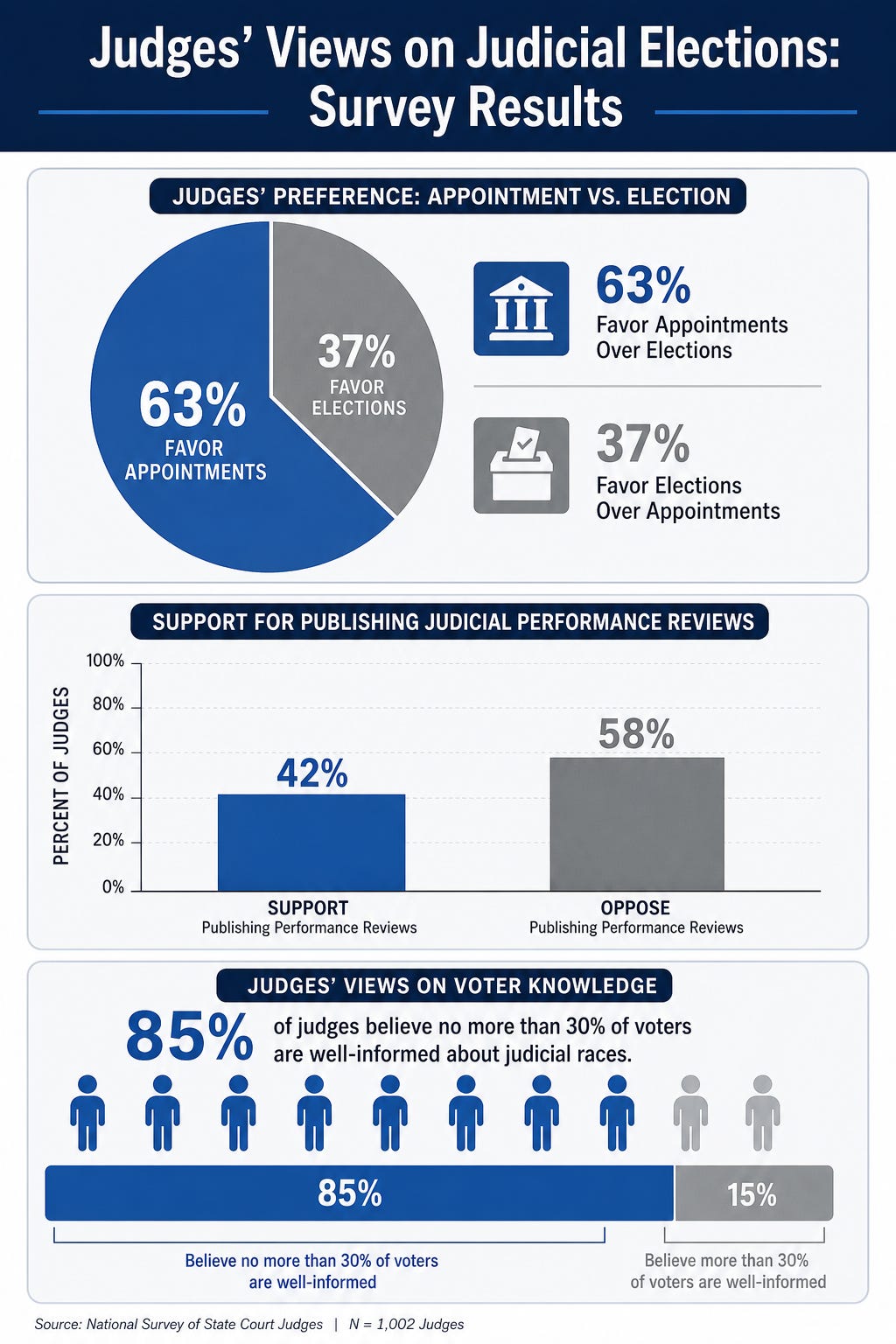
Oregon’s judicial performance transparency problem will not solve itself. A national survey of over 1,000 judges found that 63% favor appointment over election, and 58% oppose publishing judicial performance reviews. The same survey revealed that 85% of judges believe fewer than 30% of voters are well-informed about judicial races, which, given their other answers on the survey, seems to be the way they want it.
This creates a troubling dynamic. Judges acknowledge that voters lack information, yet a majority oppose providing the very performance data that would address the gap. The bench has structural reasons to resist transparency. Judges are prohibited from making endorsements in partisan political races, but they may endorse candidates in judicial elections. Indeed, incumbent judges almost always endorse each other, creating a sort of judicial back-scratching system that can mislead voters. Without performance data, these endorsements carry outsize weight because voters have little else to go on. Publishing objective metrics would not eliminate the value of judicial endorsements, but it would give voters an independent basis for evaluation.
Oregon should adopt the principle embodied in its public records law: when public officials have institutional reasons to prefer opacity, that is precisely when transparency matters most. The legislature, not the courts, should set the standards for what performance information voters receive. Oregon’s Judicial Department should be required, not asked, to publish judge-level data it already collects, supplemented by the additional metrics outlined above.
Of course, there is an alternative. We could move to a system of appointed judges, presumably managed by a judicial department that would monitor their performance. Our state administrative law judges use this model. Whether judges are elected or appointed matters less than that they are held accountable to the public effectively.
A Transparency Agenda for Oregon’s Courts
None of this requires Oregon to invent a new doctrine. It simply asks the state to apply its existing values consistently.
We already believe that the people have a right to know how their tax dollars are spent and how agencies perform. Judges hold some of the most powerful government offices in the state. They decide whether people remain in jail, whether families stay together, and whether businesses live or die. They should not be the one branch of government that asks for votes while hiding information about whether they are actually effective and hardworking public servants.
The path forward is straightforward. Disaggregate existing OJD performance data by judge and publish it annually. Add a small set of new metrics that are easy to measure, especially opinion timeliness and courtroom punctuality. Build fair peer cohorts and percentile rankings instead of raw number tables. Integrate the resulting performance summaries into the Voters’ Pamphlet.
The Oregon Legislature should require OJD to publish judge-level performance data beginning in 2027. The State Bar should launch attorney surveys this year. And the Secretary of State should integrate performance summaries into the 2028 Voters’ Pamphlet. Put simply, since we have chosen to elect judges, the voters are entitled to have the information they need to make an informed choice.
Disclaimers
In writing my columns, I depend on the representations made in the press. Some of the facts may remain in dispute.
The views expressed herein are those of the author and not necessarily those of the Department of Navy, the Department of Defense, the University of Oregon, or any other entity with which the author is affiliated. No government time or resources were used in the writing.
Keep Letters from a Recovering Politician Free
As always, the best thing you can do to support this column is to share it with people who might be interested. I do not have a paid plan because I want folks to be able to access it without worrying about money. Should you wish to contribute, you can do it with one of the first two buttons below or by signing up for a subscription through Substack. As of yet, I don’t have any plans for a paid tier, so it’s really just another way of leaving me a tip. I’ve recently starting reinvesting a part of these contributions to increasing the reach of the publication.
Sources
Core Oregon transparency and court performance sources
Oregon Judicial Department, “Reports, Statistics, & Performance Measures”
https://www.courts.oregon.gov/about/pages/reports-measures.aspxOregon Judicial Department, “Time to Disposition Standards for Oregon Circuit Courts” (2018 PDF)
https://www.courts.oregon.gov/rules/Other%20Rules/E7j99025.pdfOregon Judicial Department, “Oregon Goals for Timely Disposition – Age of Terminated Cases” (example annual report)
https://www.courts.oregon.gov/about/Documents/2022TimeToDispo.pdfOregon Legislative Fiscal Office, “Judicial Department Annual Performance Progress Report” (Key Performance Measures, including time to disposition and time to judgment entry)
https://www.oregonlegislature.gov/lfo/APPR/APPR_OJD_2024-09-26.pdfOregon Public Records Law overview (Oregon Department of Justice, “Oregon Public Records 101”)
https://www.oregon.gov/pra/Documents/Oregon-Public-Records-101.pdfOpen Oregon / Oregon DOJ quick reference guide to public records law
https://www.oregon.gov/pra/Documents/Open-Oregon-Public-Records-Guide-2019.pdfOregon Revised Statutes, Chapter 192, “Records; Public Reports and Meetings”
https://oregon.public.law/statutes/ors_chapter_192Oregon State Bar, Judicial Candidate Voting Guide (example, 2022 primary)
https://www.osbar.org/judicial/JudicialVotingGuide2022Primary.html
Judicial performance evaluation (JPE) design and theory
IAALS, “Judicial Performance Evaluation 2.0” (project overview and recommendations)
https://iaals.du.edu/projects/judicial-performance-evaluationIAALS, “Shared Expectations: Judicial Accountability in Context” (white paper)
https://iaals.du.edu/sites/default/files/documents/publications/shared_expectations_judicial_accountability_context2006.pdf
State JPE programs and election pamphlet models
Alaska Judicial Council, “Retention Evaluation Procedures” (includes Official Election Pamphlet practice and reversals/affirmance discussion)
https://www.ajc.state.ak.us/retention/retproced.htmlAlaska Judicial Council, general retention evaluation resources
https://www.ajc.state.ak.us/retention/retproced.htmlNew Mexico Judicial Performance Evaluation Commission, “Evaluation Process” (including “insufficient data” designations)
https://nmjpec.org/en/how-we-evaluate/evaluation-processColorado Office of Judicial Performance Evaluation (overview of Blue Book narrative evaluations)
https://www.linkedin.com/company/colorado-office-of-judicial-performance-evaluation
Comparative transparency and civil-society models
Our Nevada Judges (judicial database and error-rate methodology)
Home: https://ournevadajudges.com/home
About and methodology: https://ournevadajudges.com/aboutLas Vegas Review‑Journal, “Here’s what error rates can say about a judge’s performance” (uses Our Nevada Judges data)
https://www.reviewjournal.com/news/politics-and-government/heres-what-error-rates-can-say-about-a-judges-performance-3592000/Scrutinize (New York state judge profiles and transparency project)
Main site: https://www.scrutinize.org
Judge profiles: https://judges.scrutinize.org/all-judges
Background on Oregon’s low‑information legal elections
ACLU of Oregon, “Roadblocks to Reform: District Attorney Elections in Oregon” (uncontested races and voter drop‑off)
https://www.aclu.org/press-releases/aclu-releases-report-oregon-das
I agree with you that the state legislature should make this judicial reporting readily available to the public. How could we make this mandatory?
Wow, thank you for laying this out so clearly with the data and argument. I've long wondered how to select judges on my ballot. It sounds like we don't have any organizations working on this issue in Oregon. I hope someone (unfortunately not me right now) reads this and gets spurred to action, leading to options of what individual readers can do to take action and that we get a part 2 some day.