
More Administrators, Fewer Professors
Inside Oregon's Higher Education Spending Problem

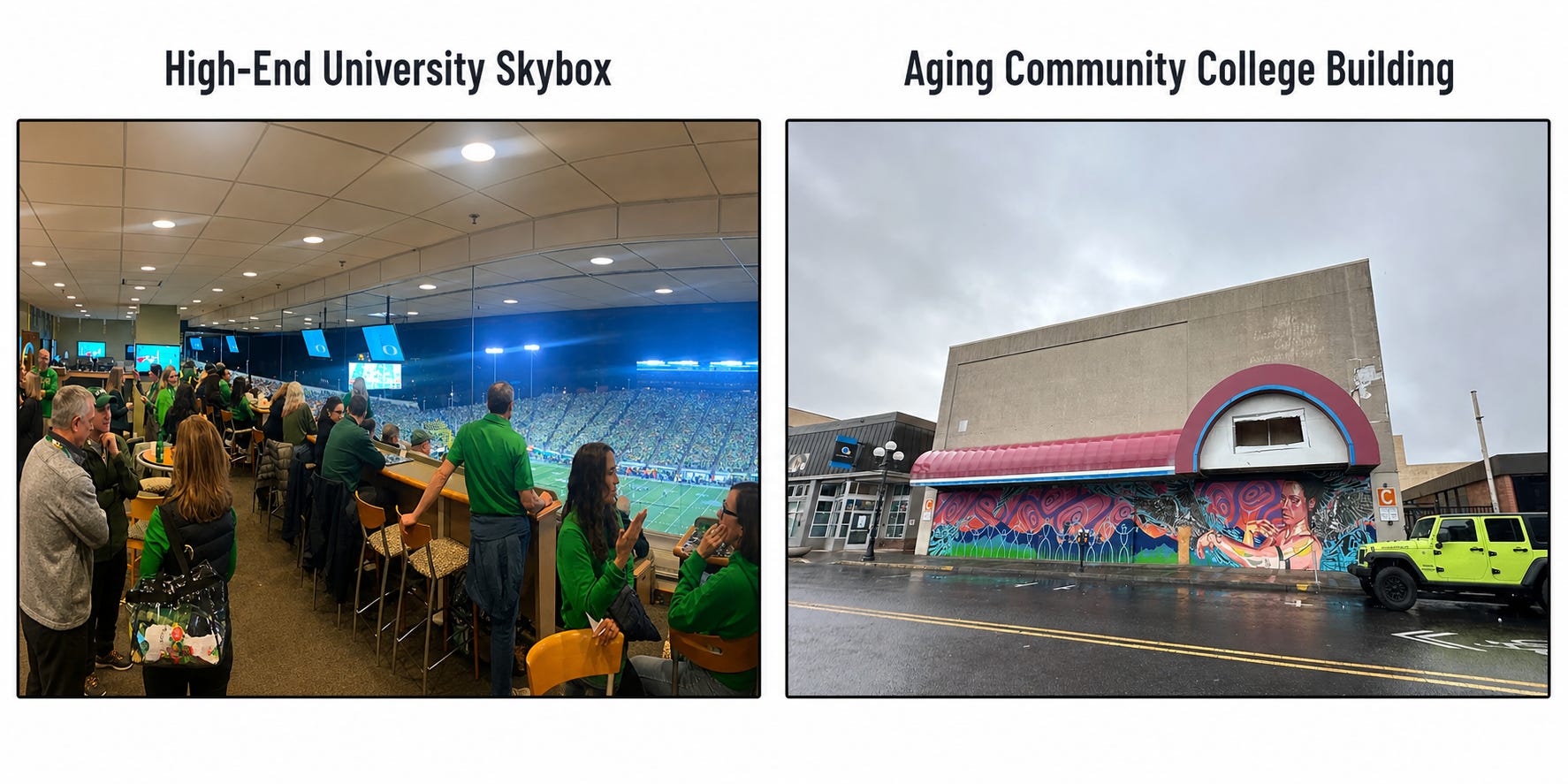
In Eugene, two public colleges charge radically different prices for the same chance for higher education. At Lane Community College in Eugene, students pay roughly $6,140 per year in tuition and fees. Across town, University of Oregon students pay about $16,800 for an experience backed by vastly more administrators. Between 2017 and 2024, UO added 257 full-time equivalent administrative positions. It added only 13 tenure-track faculty. Administrative bloat refers to disproportionate growth in non-teaching staff relative to faculty and students, driving costs without clear educational benefits.
This is not about educational quality or institutional mission. It is about the choices these institutions made to spend money on administrators that have no connection to student success. The gap between university and community college spending is not subtle. Oregon's own reporting reveals stark differences in how institutions allocate resources.
What the Numbers Show
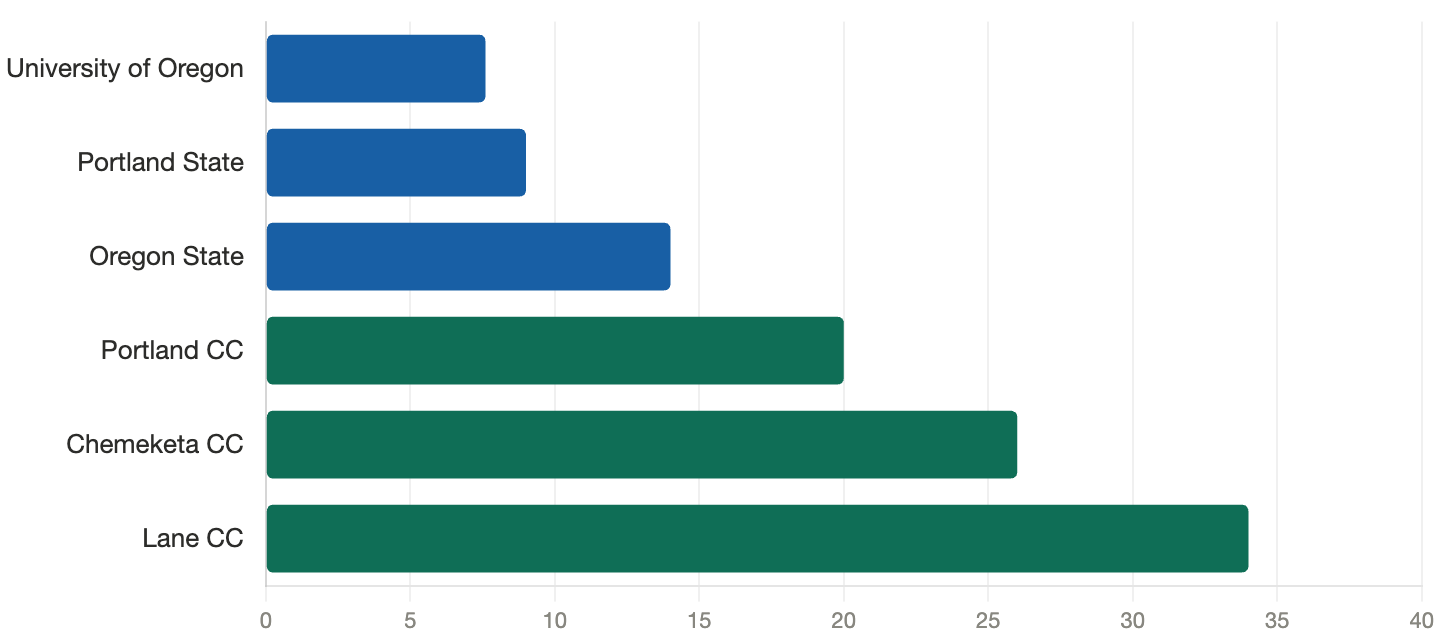
The Higher Education Coordinating Commission (Oregon's higher education oversight agency) collects staffing data from every public institution. Counting all non-faculty employees, including administrators, classified staff, and professional non-teaching employees, Oregon’s three major universities average one non-faculty staff member for every eight to fifteen students. Community colleges average one for every twenty to thirty-four. The University of Oregon runs at roughly 7.6 students per non-faculty staff member. Lane Community College runs at about 34. The gap is real, with roughly two to three times more non-faculty staff per student at universities.
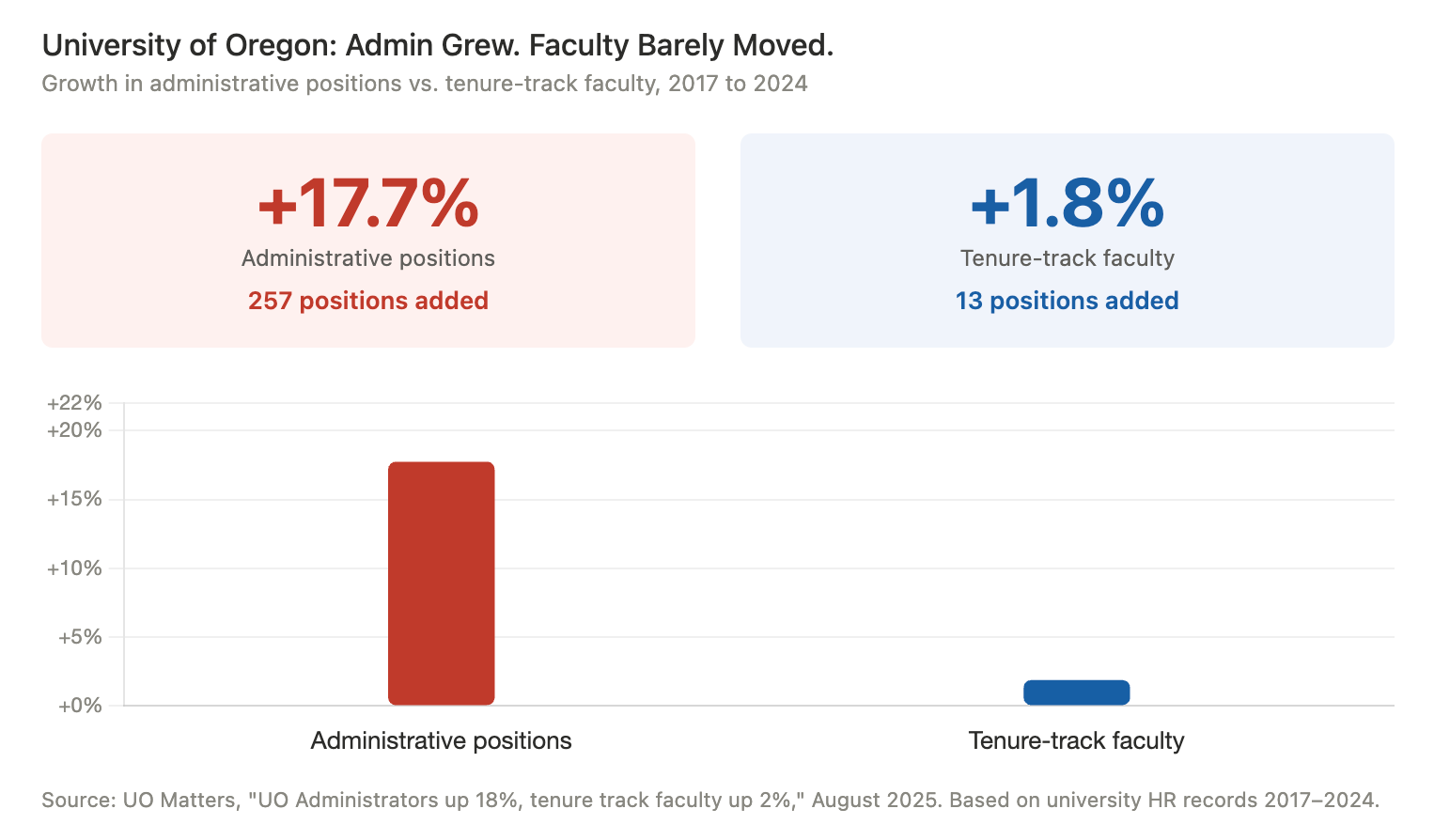
The most informative comparisons look within institutions rather than across them. Between 2017 and 2024, UO added 257 administrative positions and 13 tenure-track faculty, resulting in 17.7 percent growth in administration against 1.8 percent growth in instruction, at the same institution, counted by the same method. At Portland State, administrative spending per student doubled even as enrollment fell 23 percent since 2019. Nationally between 2010 and 2018, fundraising spending grew 35 percent, student services grew 29 percent, research support grew 24 percent, and instruction grew 17 percent. The money went everywhere but the classroom.
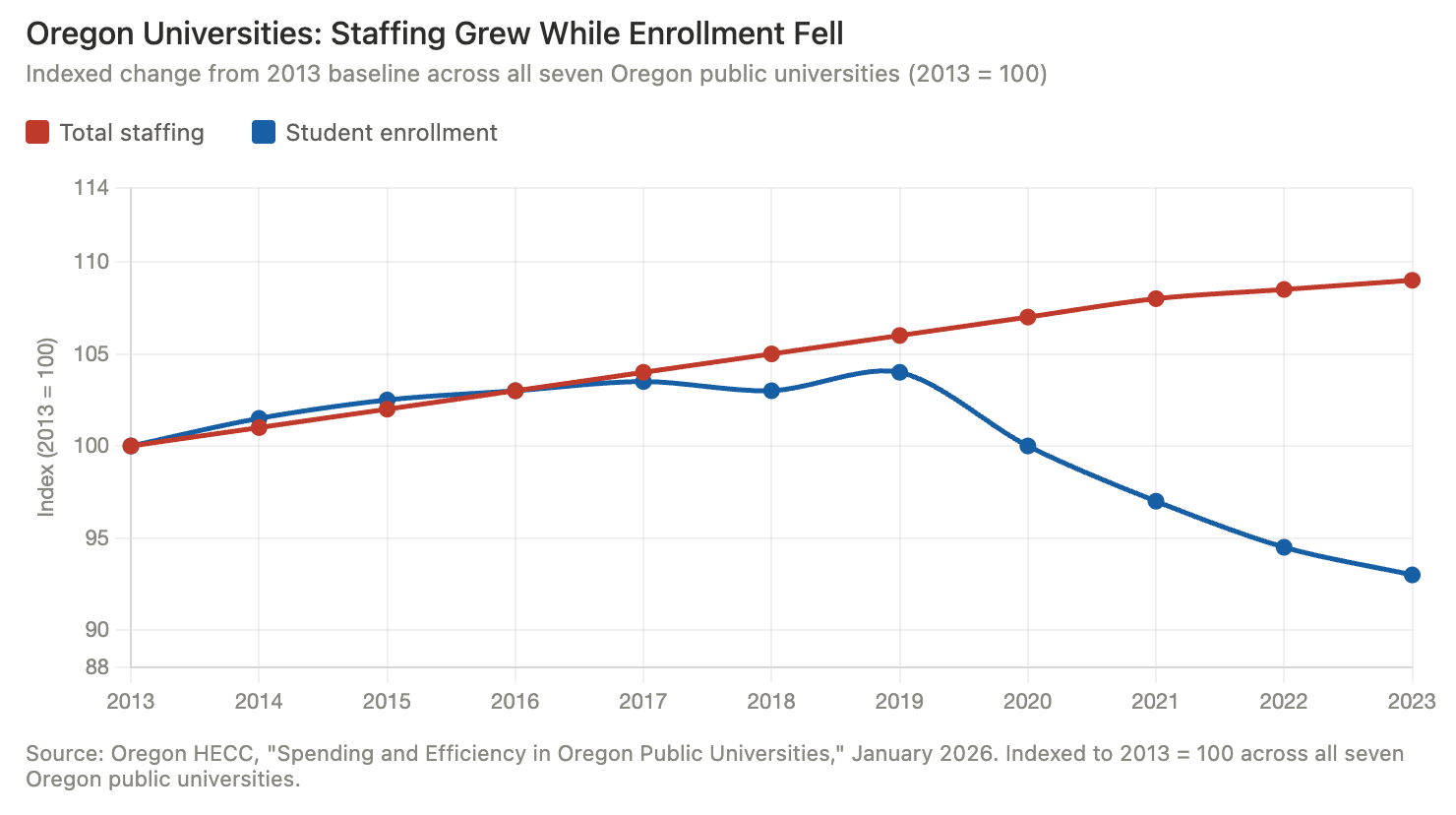
A January 2026 HECC report to the legislature confirmed the statewide pattern. Staffing across all seven Oregon universities grew nine percent from 2013 to 2023 while enrollment declined seven percent. The share of budgets directed to instruction fell from 43 percent to 37 percent. Spending on institutional support grew from 14 to 19 percent. Oregon universities now carry 27 percent fewer students per staff member than the national average for public four-year institutions.
What Drives the Bloat
Institutions raise spending to match available revenue, not educational need. The economist Howard Bowen proposed what is now called the Revenue Theory of Cost. When federal student loan limits expanded, universities faced no external constraint on tuition growth. Each new federal regulation, including Title IX, Clery Act, FERPA, and export controls, became justification for new administrative positions.
Fundraising offices expanded to offset declining state support, becoming self-sustaining hierarchies raising money to fund more fundraising capacity rather than instruction. These positions bring in money, but that money is not dedicated to instruction. Similarly, admissions staff has ballooned, chasing the international and out-of-state students who pay full freight, without adding anything to student success. This was driven by the conscious decision to address declining state support through this approach, rather than making cuts and refocusing on the educational mission.
Community colleges are not lean because they lack resources. Their combined state appropriations and local property tax revenues are comparable to what universities receive in state support alone. They face identical federal compliance burdens. They serve students with demonstrably greater economic stress. The primary difference is accountability. Community colleges answer to local taxpayers who see property tax levies on their bills. Universities, insulated by unlimited federal student loans and higher per-student state appropriations, face no comparable external constraint.
What Students Actually Get
Universities defend administrative growth by pointing to genuine services like mental health counseling, Title IX coordination, disability accommodations, and career advising. But student-to-counselor ratios at many universities remain worse than professional standards recommend despite years of administrative growth. There is no clear correlation between administrative spending increases and improved retention, graduation rates, time-to-degree, or post-graduation employment. Universities are spending more on student services, but it’s not clear that the spending is driving better outcomes for students. For instance, over the past 10 years, Portland State doubled its administrative spending per student while enrollment fell 23 percent, without proportional gains in student outcomes.
Administrative positions are difficult to eliminate. Once created, they justify their own existence, generate new reports that require more staff, and embed in institutional culture. The recent elimination of DEI offices at over 400 campuses under federal pressure creates an unintended natural experiment. Preliminary reporting suggests many positions simply migrated to other departments under new titles. If universities can eliminate entire administrative categories without educational harm, it raises a direct question about whether the growth was necessary in the first place. There is reasonable evidence that well‑designed equity initiatives focused on instructing students in need help underrepresented students, but far less proof that adding DEI administrators results in measurable gains in graduation or learning.
What Oregon Could Do
Oregon already collects the data. The question is whether university presidents and legislators will act on it. The HECC’s January 2026 Spending and Efficiency report, prepared for this year’s legislative session, calls on the legislature to pursue targeted institutional integration and require HECC to periodically review and renew academic degree programs. When the agency charged with oversight is demanding structural change, the argument for inaction goes from weak to non-existent. Five further reforms would impose the accountability that unlimited federal loans have removed.
First, require universities to publish and justify student-to-administrator ratios annually, compared to community colleges and peer institutions in other states. Second, tie a portion of state appropriations to a commitment that administrative FTE growth cannot exceed instructional FTE growth over any five-year period. Third, require functional spending disclosure breaking administrative costs into subcategories, including compliance, fundraising, student services, and institutional support, so legislators can distinguish mandated positions from discretionary overhead. Fourth, benchmark against community college ratios, requiring public hearings before Ways and Means when a university’s ratio exceeds twice the community college average. Fifth, link administrative spending on student support to measurable outcomes, requiring institutions to report retention and graduation rates alongside administrative spending per student cohort.
None of this prevents universities from hiring administrators when genuinely needed. It creates accountability for the administrative bloat that Oregon currently funds without scrutiny.
What Is at Stake
Oregon’s community colleges prove that lean higher education is possible even with compliance burdens, diverse student needs, and budget constraints. The bloat at four-year institutions is not inevitable. It is a choice enabled by unlimited federal loans, higher per-student state support, and institutional cultures that treat administrative growth as normal rather than a symptom of an underlying problem.
That reckoning is already arriving. Oregon’s seven public universities collectively planned $85.1 million in cuts for FY2026. Southern Oregon University declared financial exigency in August 2025 and recently received a $15 million bailout to give it time to make thoughtful, rather than precipitous, reductions. UO is laying off 117 faculty and staff to close a $25 to $30 million structural deficit. Portland State’s plan calls for $35 million in cuts through what administrators are calling instructional portfolio rebalancing. When the money runs out, it is programs and instructional staff that get cut, not the administrative structures that expanded during the growth years.
The students paying an additional $10,000/year at universities deserve to know whether that premium buys better teaching and learning, or just more layers of administration. The students at community colleges paying half as much deserve to know why the state appropriates more per capita to universities yet tolerates such divergent overhead. Both are Oregonians paying for public higher education. The return on investment should not depend on which sector they can afford to access.
Will legislators will use the data to hold universities accountable or will administrative bloat will keep growing? Absent a change in priorities, our future budget cuts will target instructional staff, not administrators. And Oregon’s university students and taxpayers will continue to get less than they pay for.
Are you a college student, former student, or parent of a student? Let me know about your experiences paying for college.
Know someone who might be interested in college affordability? Please share.
Beta Readers Sought
If you’d like an earlier peak at some of my columns and give me feedback, send me an e-mail at wildefororegon (at) gmail.com. There’s no obligation. It’s always good to have more sets of eyes on the work before it goes out in its fina
Disclaimers
In writing my columns, I depend on the representations made in the press. Some of the facts may remain in dispute.
The views expressed herein are those of the author and not necessarily those of the Department of Navy, the Department of Defense, the University of Oregon, or any other entity with which the author is affiliated. No government time or resources were used in the writing.
Keep Letters from a Recovering Politician Free
As always, the best thing you can do to support this column is to share it with people who might be interested. I do not have a paid plan because I want folks to be able to access it without worrying about money. Should you wish to contribute, you can do it with one of the first two buttons below or by signing up for a subscription through Substack. As of yet, I don’t have any plans for a paid tier, so it’s really just another way of leaving me a tip. I’ve recently starting reinvesting a part of these contributions to increasing the reach of the publication.
References and Sources
Oregon Higher Education Coordinating Commission, “ORS 350.360: Higher Education Staffing Report 2023”
UO Matters, “UO Administrators up 18%, tenure track faculty up 2%”, August 2025
Ramin Farahmandpur, “PSU’s Fiscal Plight”, Academic Gadfly, March 2026
Oregon Journalism Project, “Oregon’s Education Workforce Climbed While Student Enrollment Slid”, February 2026
Cornell University, “Unraveling Administrative Bloat”, May 2025
Robert Kelchen, “Is Administrative Bloat Really a Big Problem?”, May 2018
Progressive Policy Institute, “How to Cut Administrative Bloat at U.S. Colleges”, August 2023
James G. Martin Center, “Administrative Bloat Harms Teaching and Learning”, August 2022
Academic Jobs, “DEI Program Adjustments: Campus Changes Under Pressure in 2026”, January 2026
CUPA-HR, “The Development, Fundraising, and Alumni Relations Workforce in Higher Education”
Oregon HECC, “Community College Funding”
Oregon HECC, “State Funding and Formula Summary 2023-2025 Biennium”
Center for American Progress, “Tapping Local Support To Strengthen Community Colleges”, February 2023
State Higher Education Executive Officers, “Oregon State Profile”, SHEF Database
The Hechinger Report, “States and localities pump more money into community colleges than four-year campuses”, June 2022
Oregon HECC, “Higher Education Employees Annual Report, November 2024”
Oregon HECC, “Spending and Efficiency in Oregon Public Universities”, January 2026
I was on the faculty at UO from 1996 to 2023, so I experienced this creeping (and sometimes galloping) bloat, which was mostly coupled (with a welcome hiatus during Lariviere's presidency) with whining about how it was just impossible to pay UO faculty members salaries comparable to similar universities. There was just no money available, see?
Some administrators (often but not always ones who were formerly faculty members) are competent and make life better for students and faculty and staff. Many, instead, spend their time in ways that make things worse, creating obstacles to effective use of our time on teaching and research. The middle ground of useless (having no discernible positive OR negative impact) still comes with an (often bloated) salary.
Seems analogous to those obstructive, meddling layers of management Peacehealth wanted to add with Apollo MD to the detriment of doctors, nurses, and other productive staff whose direct work is serving patients.
I was staff in an academic dept at UO for 30 years and could see what you are describing, but I was unable to articulate what exactly I was “intuiting.” Is there a resource where hopeful soon to be students can research finding the “best bang for your buck” in their region?