

If you live in Eugene, you do not need a white paper to know that everything feels more expensive. Rents are high, houses are drafty, and winter utility bills can feel like a second mortgage. Small businesses are squeezed between higher costs and customers who cannot afford to pay much more. At the same time, 4J and Lane Community College are cutting and pruning, even as students need clear paths into the jobs of the future.
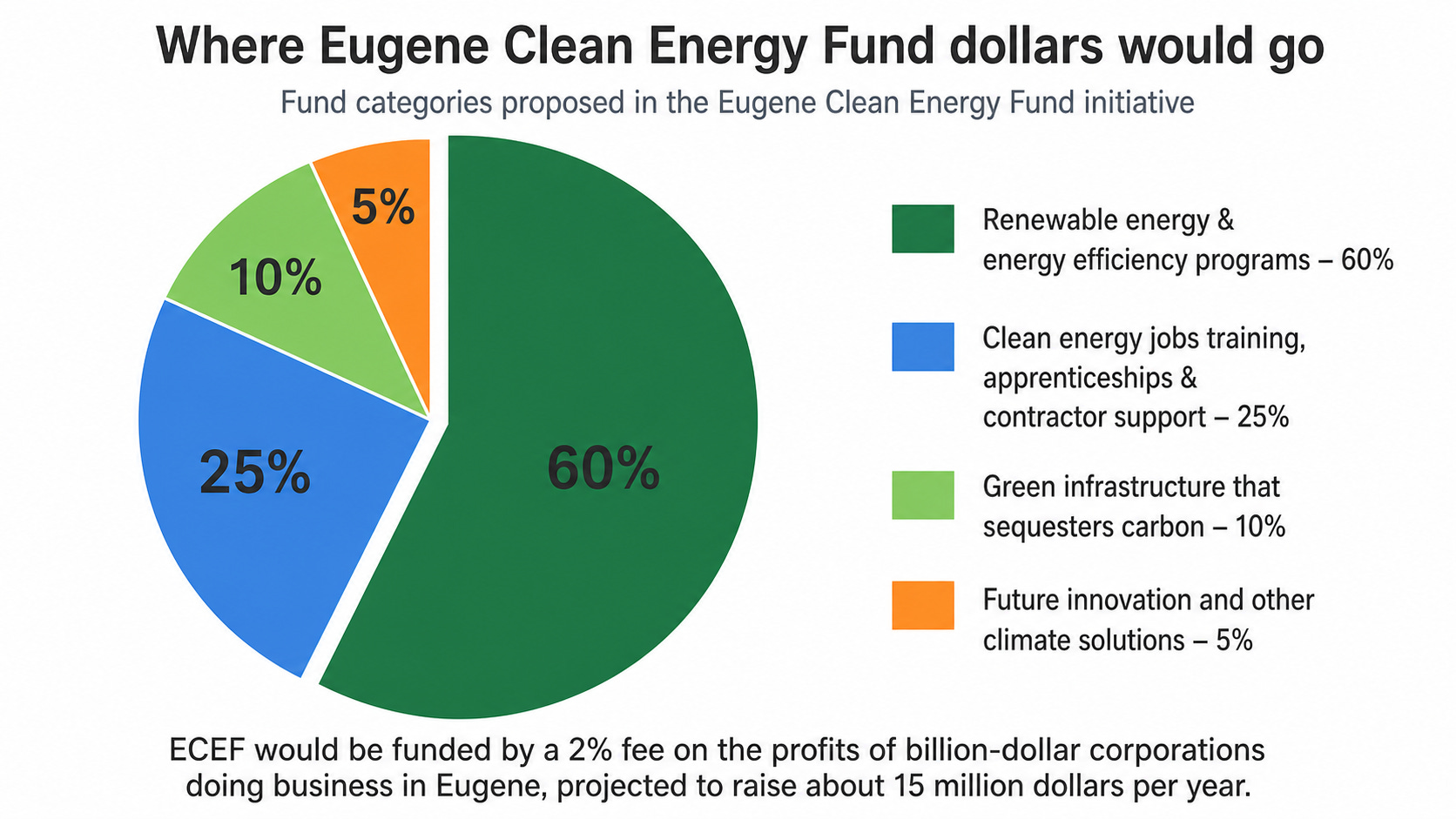
The proposed Eugene Clean Energy Fund (ECEF) would charge a 2 percent fee on the local profits of billion dollar corporations doing business in Eugene and direct the proceeds, about $15 million a year, into clean energy and climate resilience projects. Supporters tend to talk about emissions and climate justice, while opponents call it a climate tax. Both frames miss a simpler and more pragmatic point. If we design it well, ECEF can function as an affordability engine for individuals, small businesses, and public education.
I want to explore three ways this measure could make life more affordable in Eugene. It can cut monthly costs for residents, stabilize energy costs for small businesses, and help schools fund education in the clean energy jobs of the future.
1. Affordability for individuals: cutting monthly bills, not just emissions
For many Eugene households, especially renters, the problem is not only the price of energy. The buildings themselves are a big part of the burden. Older rentals with minimal insulation, leaky windows, and inefficient heating systems force people to burn far more kilowatt hours or therms than they should just to stay warm. When you are paying a large share of a modest paycheck to heat the outside, your home effectively carries its own regressive energy tax.
The Eugene Clean Energy Fund is structured in a way that directly targets this problem. Sixty percent of ECEF revenue is earmarked for renewable energy and energy efficiency programs. That is the largest slice of the fund and it is where the affordability gains are easiest to realize. In practical terms, this means fully insulating and air sealing drafty multifamily buildings, replacing baseboard heaters and old gas furnaces with high efficiency electric heat pumps, and upgrading common area lighting and controls in older rental housing.
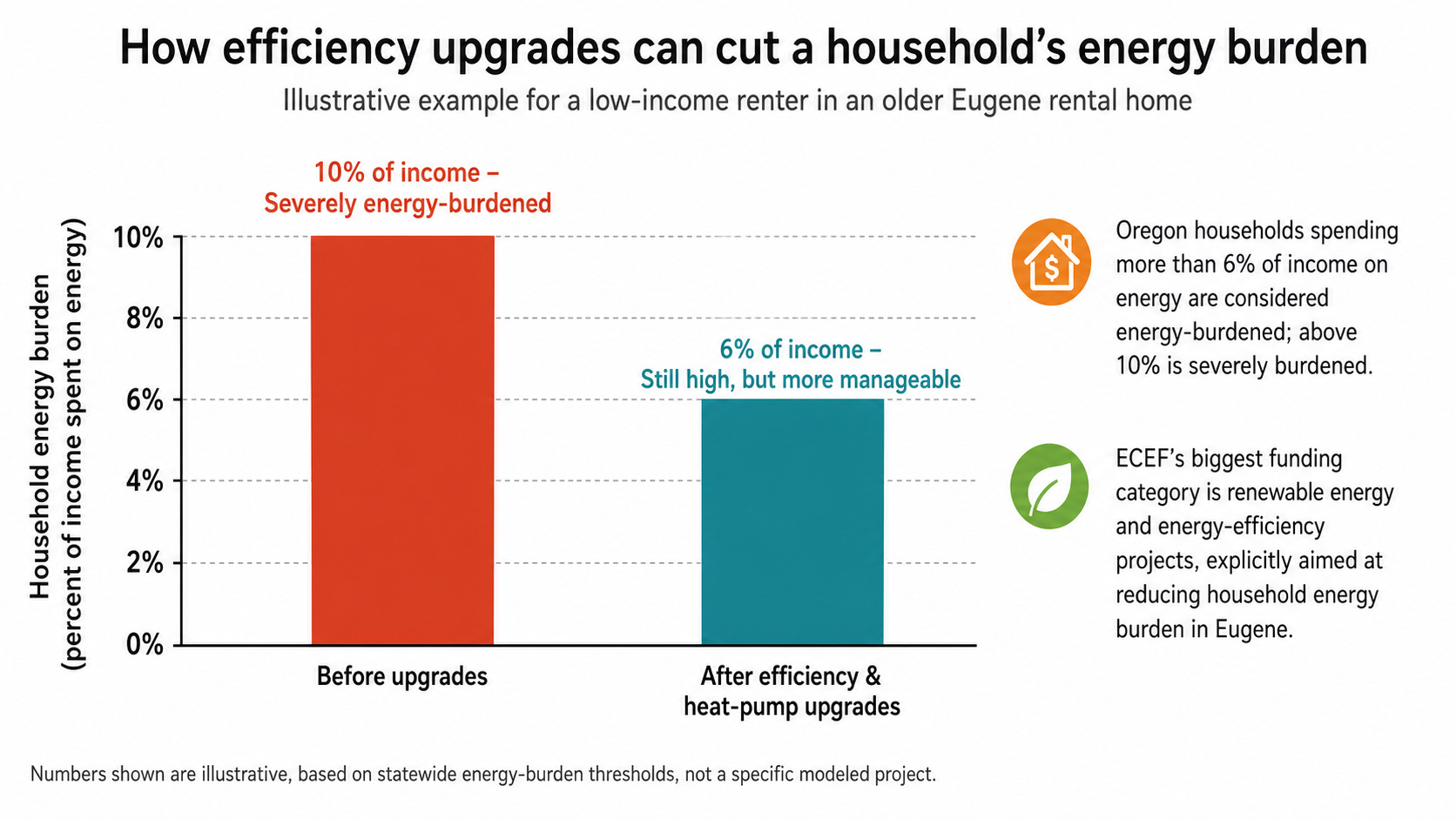
Imagine a typical four unit building in the Whiteaker. Right now, each tenant pays high winter bills to heat a space that leaks energy through walls, windows, and ducts. With ECEF support, the building can be upgraded with insulation in walls and attic, better windows and doors, and a cold climate heat pump system that both heats and cools efficiently. The tenants do not see an abstract climate project. They see winter bills that are perhaps 20 to 30 percent lower and apartments that are more comfortable, year after year. That is consistent with how Portland’s Clean Energy Fund has financed energy efficiency upgrades in affordable housing. This also makes EWEB cheaper and more reliable, since it tends to reduce expensive unexpected demand peaks.
Eugene already has some utility and state incentives that nudge in this direction, but they rarely cover the full cost and are not designed to be truly accessible to low income renters. ECEF can play the role of flexible last dollar fund, the piece that closes the gap after federal tax credits, state programs, and utility rebates have done their part. That is how you shift from a system that works only if you can front thousands of dollars and navigate a rebate maze to one where landlords can upgrade without huge rent hikes and tenants see savings on their next bill. As it uses existing incentive structures, it also saves money on administrative overhead, putting more money toward affordability.
ECEF is a way to reduce household energy burden and improve home comfort, expand public owned renewable energy and green infrastructure, create jobs, and build climate resiliency. This bills first implementation prioritizes the people who need it most.
2. Affordability for small businesses: stabilizing costs and supporting local jobs
If individuals feel squeezed, small businesses feel it twice. A local café or contractor in Eugene has to manage rent, payroll, inventory, and insurance along with energy and fuel costs that they cannot fully control. Unlike the big box chains that ECEF targets, local firms do not have a national balance sheet to cushion shocks from a cold snap or a spike in gasoline prices.
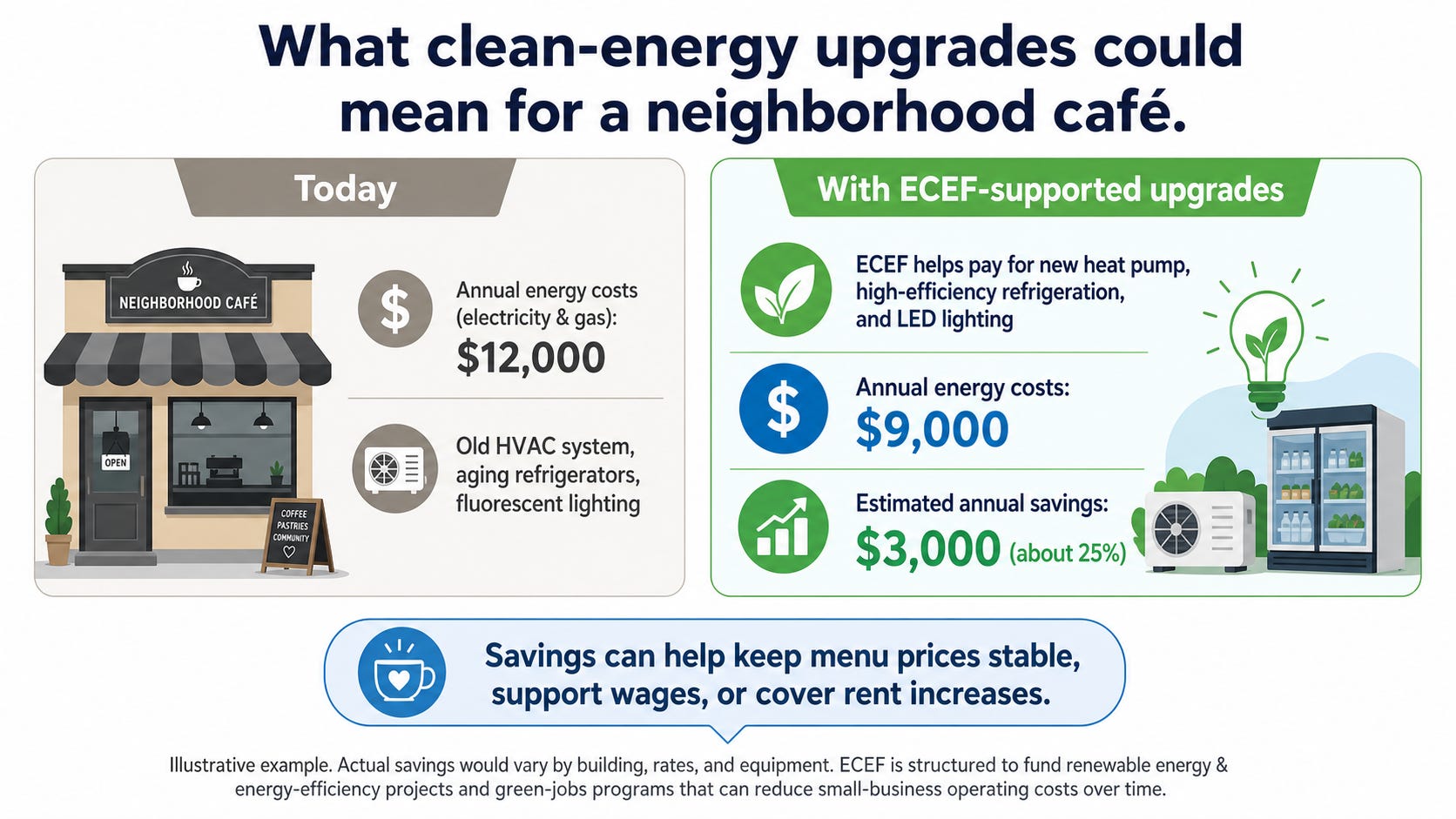
The same tools that help households can bring real relief to small businesses. A small storefront or restaurant faces many of the same energy challenges as a home, including aging heating and cooling equipment, poor insulation, inefficient lighting, and for food service, and old refrigeration units. ECEF grants or low interest financing could help a neighborhood café upgrade its HVAC system, refrigeration, and lighting to high efficiency equipment. For the owner, the result is not a talking point about climate. It is lower and more predictable utility bills and a little more room to keep menu prices steady or pay employees more.
Transportation is another major cost where clean energy investments can improve affordability. Tradespeople, delivery drivers, childcare providers, and many other small businesses spend heavily on fuel and vehicle maintenance. Electric vehicles are not a silver bullet, but when paired with on site or nearby low-cost charging and layered with state and federal incentives, they can significantly cut per mile costs and reduce maintenance requirements. The City of Eugene and EWEB already treat EV charging as part of their clean energy and electric mobility strategy, and they offer incentives for both residential and business charging.
ECEF can help in two complementary ways. First, it can fund Level 2 chargers at small commercial sites, such as service yards, small offices, or mixed use buildings, in line with its broad mandate to support renewable energy and energy efficiency programs and green infrastructure. Second, it can act as a gap filler after existing EV and charger incentives have been applied, making it possible for a small business to begin fleet electrification without blowing up its capital budget.
There is also a local multiplier story here. Every dollar a neighborhood business does not send to a utility or oil company can stay in the local economy, in wages, purchases from other local suppliers, or simply in staying open during lean months. If the measure shifts even a fraction of our commercial energy and fuel spending into long term cost lowering investments, that becomes a real affordability dividend for the community.
3. Making education in the jobs of the future more affordable
The third affordability angle is less obvious but just as important. It concerns how we pay for education and training in the very jobs that this transition will require.
Eugene School District 4J is facing budget shortfalls and hard conversations about cuts. Lane Community College has dealt with years of enrollment and funding challenges while trying to maintain its core technical and transfer programs. At precisely the moment when we need more electricians, heat pump installers, building energy auditors, solar and battery technicians, and EV maintenance specialists, our public education systems are being asked to do more with less.
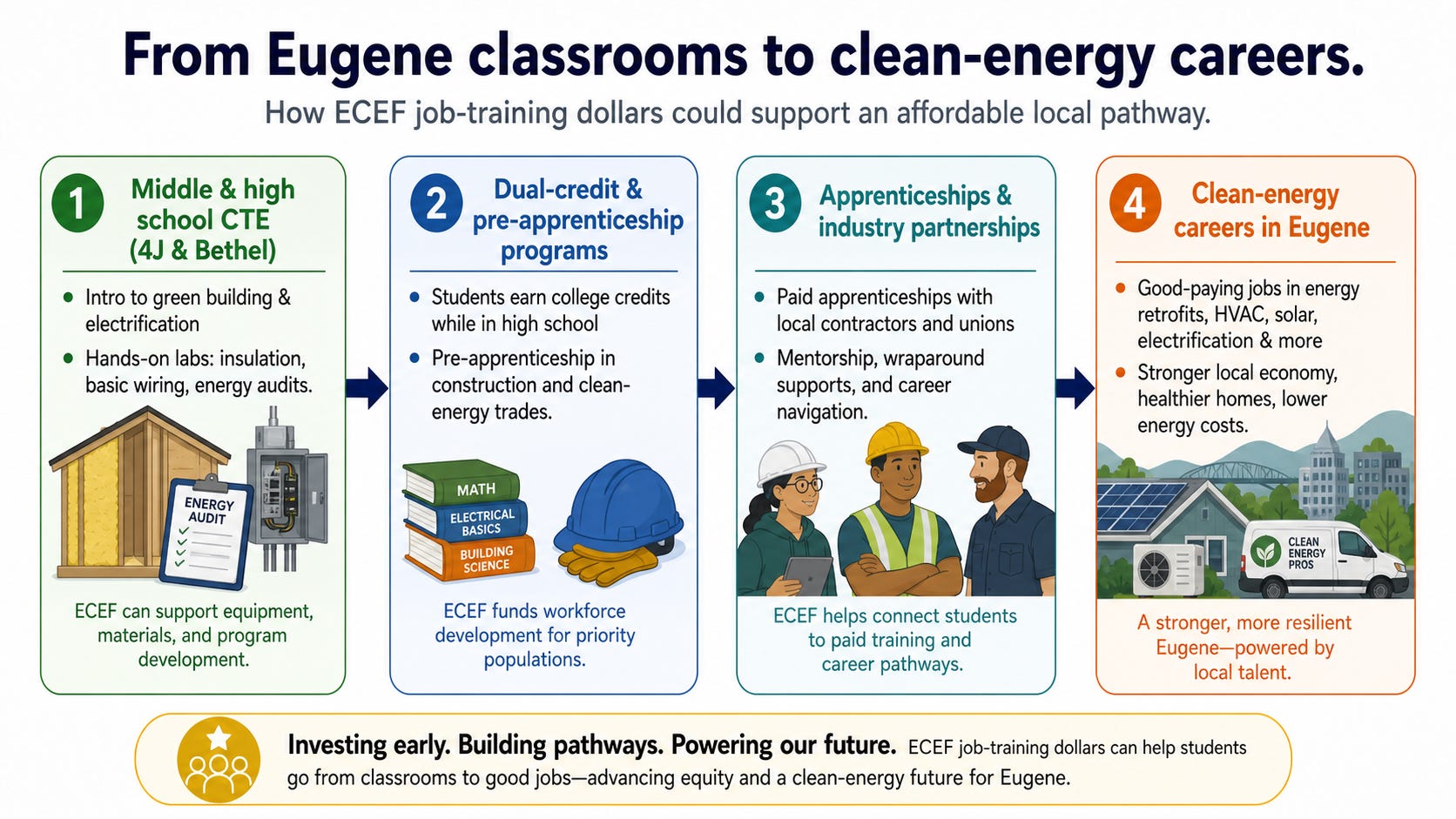
ECEF dedicates about 25 percent of its revenue to clean energy jobs training, apprenticeships, and contractor support. The initiative text describes this bucket in broad terms as workforce development, job training, and state registered apprenticeship programs for workforce priority populations, not just university students. That gives the City and community partners room to support a continuum of career and technical education that starts in middle and high school and runs through LCC into apprenticeships and employment.
In concrete terms, this could mean helping 4J and Bethel create or expand CTE pathways in green building, electrification, and energy systems. Students could learn the basics of weatherization, heat pump installation, residential solar, or building controls in labs and shop spaces that are partially funded through ECEF. Dual credit or pre apprenticeship programs could allow high school students to earn Lane Community College credits in energy related fields while still in school, reducing both the time and the cost required to reach a first family wage job.
At LCC, ECEF dollars could help pay for scholarships, stipends, or tool grants for students from low income households. The fund could also support partnerships with unions and local contractors to build clear, subsidized bridges into state registered apprenticeships, where students earn while they learn. The result is not only more workers for the projects ECEF funds, but a better paid local workforce that can afford rent, utilities, and childcare. That too is a form of long term affordability.
All of this fits comfortably within regional practice. Oregon is already investing in clean energy workforce training through grants that support community colleges, high school CTE, trade organizations, and apprenticeship programs, with explicit priorities for environmental justice communities and households with inadequate heating and cooling. Portland’s Clean Energy Fund, which ECEF is modeled on, has also funded youth focused clean energy training and pre apprenticeship efforts.
Affordability First
ECEF is a chance to turn a small slice of big corporate profit into lower monthly bills for residents, more stable cost structures for small businesses, and better funded pathways into the jobs of the future. Voters are understandably wary of anything that sounds like it will raise their costs. The case for this measure will be stronger if proponents can point not only to tons of carbon avoided, but also to simple and concrete outcomes. A winter power bill that went down, a favorite café that stayed open, a local graduate who stepped into a well paid job installing the very equipment that makes our homes cheaper to heat and cool.
If we choose an affordability first implementation that prioritizes energy burdened households, small businesses without corporate backing, and education systems under fiscal stress, then this measure does more than help us meet climate goals. It helps make Eugene a place where more of us can actually afford to live, work, and learn.
Disclaimers
In writing my columns, I depend on the representations made in the press. Some of the facts may remain in dispute.
The views expressed herein are those of the author and not necessarily those of the Department of Navy, the Department of Defense, the University of Oregon, or any other entity with which the author is affiliated. No government time or resources were used in the writing.
Keep Letters from a Recovering Politician Free
As always, the best thing you can do to support this column is to share it with people who might be interested. I do not have a paid plan because I want folks to be able to access it without worrying about money.
Sources
Eugene Clean Energy Fund, official site, https://www.eugenecleanenergyfund.org
Eugene Clean Energy Fund, About page (spending categories and goals)
https://www.eugenecleanenergyfund.org/aboutCity of Eugene, proposed Eugene Clean Energy Fund ordinance (2026‑1)
https://www.eugene-or.gov/DocumentCenter/View/81922/2026-1-Proposed-LegislationOPB, “Eugene groups propose climate tax to mirror Portland’s” (Feb. 22, 2026)
https://www.opb.org/article/2026/02/23/eugene-clean-energy-fundKVAL, “Proposed Eugene Clean Energy Fund projects $15 million from a 2% fee on major firms” (Feb. 22, 2026)
https://kval.com/news/local/eugene-ballot-measure-would-charge-big-firms-2-fee-to-fund-clean-energy-projectsOregon Energy Fund, “New Data Shines a Light on Oregon’s Energy Burden” (2021)
https://www.oregonenergyfund.org/oregon-energy-burden-studyOregon Legislature briefing, “Energy Burden: Oregonians in Need of Assistance” (2020)
https://olis.oregonlegislature.gov/liz/2020R1/Downloads/CommitteeMeetingDocument/211740EWEB, Electric Vehicle incentives for residents
https://www.eweb.org/rebates-and-savings/electric-mobility/ev-incentivesEWEB, EV incentives and rebates for businesses and multifamily
https://www.eweb.org/environment-and-climate/electric-mobility/ev-incentives-businessOregon Department of Energy, Energy Efficiency Technologies Information and Training Fund
https://www.oregon.gov/energy/Incentives/Pages/EETIG.aspx
Regarding your poll...If forced to prioritize, I’d say reducing household energy bills, because when families have breathing room, it ripples outward to small businesses and education affordability too.
So, that was my vote! :)
Thanks, Marty. I completely agree with Micki. And I’m wondering what the best way is for individuals to support the proposal.