
The Long Shadow of the 'Last Supper'
How a Pentagon Dinner in 1993 Made Us Afraid to Innovate

A Ukrainian soldier guides a $400 drone through a tree line and drops a modified grenade through the open hatch of a $2 million Russian armored vehicle. Confronted with an existential threat, the Ukrainian military adapted quickly and developed an agile defense infrastructure to meet their needs. American officers watched videos like this for three years. Then, largely, they went back to buying the same expensive, exotic weapons systems they had just watched being systematically destroyed by new, cheap delivery systems.
The drone is the symptom. This is a story about the disease, which was created at a dinner table in 1993 and about the young officers who are paying for it today.
The Dinner
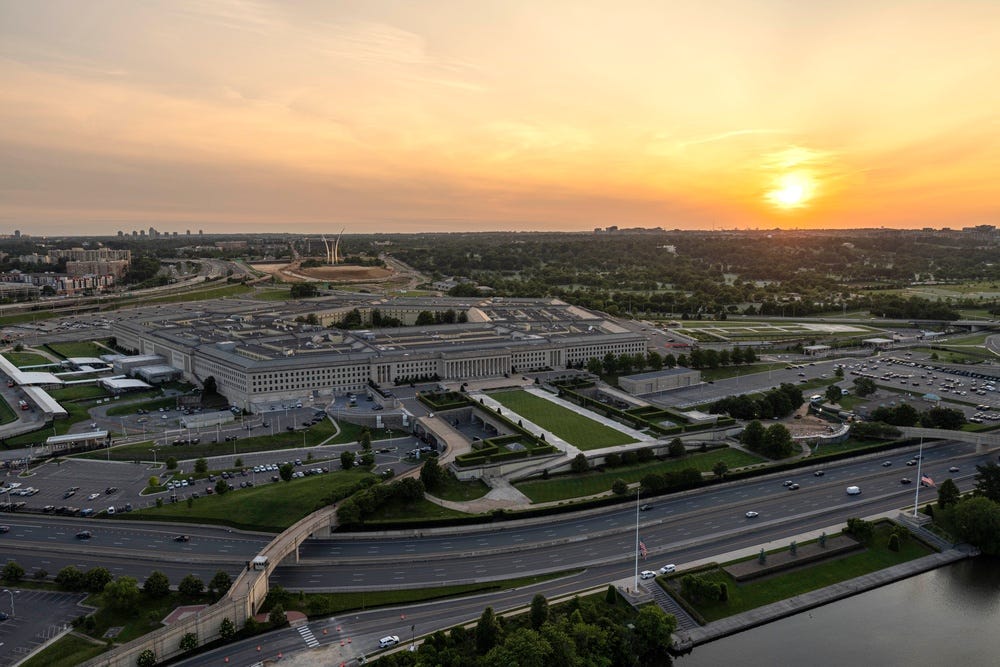
On July 21, 1993, Secretary of Defense Les Aspin and Deputy Secretary William Perry summoned the CEOs of America’s largest defense contractors to dinner at the Pentagon.1 The Cold War was over. Defense budgets had fallen more than 15 percent.2 Perry brought charts showing how many companies the Pentagon could actually sustain. In some categories, the number was one.3
I remember how lean those years were.
In 1991, as a college student attending a presentation on the Air Force’s next-generation fighter program, I saw a jet that did not fly operationally until 2006. The gap between the promise and the delivery was fifteen years.
In 1994, when my infantry platoon of 54 soldiers trained on the anti-tank weapons critical to our survival on the battlefield, only one of us got to fire the weapon. Fifty-three soldiers trained for a threat they could not practice defeating.
By 1997, our infantry brigade was one of only two in the entire Army National Guard to participate in the training rotation necessary to certify us for overseas service. That distinction spoke more to budget constraints than to our superiority over the other units.
Times were equally lean for the defense industry. By 1997, 51 major defense contractors had consolidated into five companies. Lockheed absorbed Martin Marietta.4 Boeing absorbed McDonnell Douglas. Northrop absorbed Grumman. The Pentagon got the appearance of efficiency. It traded away the competitive pressure necessary for innovation.5
A company holding a 20-year sustainment contract has no reason to propose something that would cannibalize it. A program manager who cancels an expensive failure is ending a career rather than saving money. These incentives produced the “exquisite system” bias that now defines major procurement. Requirements inflate through layers of review into decade-long engineering projects. The F-35 began formal development in 2001 and reached full operational capability until 2023, carrying a projected lifetime cost exceeding $1.7 trillion.6
The Uninvited Guest
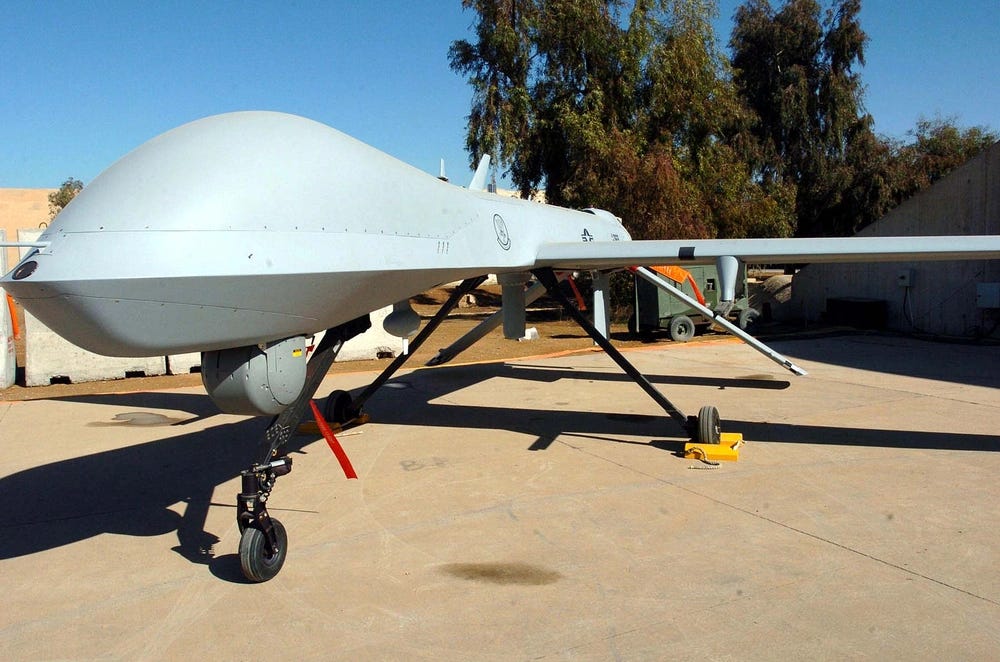
General Atomics was not at the Last Supper dinner. Neal Blue and his brother Linden bought it from Chevron in 1986 for $60 million when it was a struggling nuclear firm with no legacy weapons programs to protect.7 In 1992, they recognized that unmanned aerial vehicles (UAVs) were undervalued and they moved early.8
The Predator’s lineage begins even further outside the system, with Abraham Karem, an Israeli engineer who built early UAV prototypes essentially in his garage before his company went bankrupt. The CIA bought his designs. General Atomics developed them into something deployable.9 The major contractors were not interested until the capability was proven.
General Atomics built the Predator around commercial off-the-shelf components wherever the mission allowed. Mil-spec parts are more durable, and far more expensive, since they are sourced from a captive market. Commercial off-the-shelf parts come from a competitive ecosystem where prices are driven by volume. The Predator was cheaper to build and easier to maintain in part because General Atomics had no internal divisions that needed the work. The primes could not make that same choice without undercutting their own business units.10
The same logic applies outside defense. Apple’s decision to source components from external manufacturers rather than build captive internal supply chains gave it cost flexibility and manufacturing scale that vertically integrated competitors could not match.11
General Atomics succeeded because it had the structural freedom the primes had eliminated from themselves. When I investigated a Predator crash for the Air Force, the central question was whether the mil-spec sensor ball could be salvaged. It cost more than the entire rest of the aircraft, which was built from commercial parts. That single detail captures the whole problem.
General Atomics is now itself a major defense contractor, with billions in annual revenue and its own entrenched program relationships. The point is not that General Atomics was uniquely virtuous. The point is that the structural conditions that allowed it to innovate in the 1990s no longer exist for any new entrant, including General Atomics itself.
Why General Atomics Was Agile and the Primes Are Not
General Atomics’ asset-light structure meant it could rely on stocks of parts easily available in the commercial market and was not tied to a single supplier. In military terms, it acted more like an insurgent forced to innovate quickly than a prime contractor with a guaranteed return. Defense primes are built in the opposite direction. Consolidation in the 1990s did not just reduce the number of prime contractors. It pulled subsystem makers inside those primes. When Northrop absorbed Grumman and Raytheon absorbed Hughes, they absorbed captive internal suppliers. A prime that owns its own avionics division has a financial interest in sourcing from that division even when an outside supplier would be faster or cheaper.
The supplier ecosystem that remains outside reflects this. A company making specialized mil-spec components for a fighter avionics system may have two or three viable customers in the world. It cannot credibly threaten to take its business elsewhere. The prime cannot credibly threaten to replace it. Both sides are locked in, and neither has incentive to push hard on cost, speed, or innovation.
None of this requires abandoning military-grade standards where they genuinely matter. Propulsion systems, hardened communications, and weapons interfaces operate in environments no commercial supplier designs for. Mil-spec sourcing there is an engineering necessity. But the sensible approach is justification at the component level, which means keeping mil-spec where the threat environment specifically requires it and defaulting to commercial parts everywhere else. The primes do not do this because their internal business units need the work.
When I served at Air Force Special Operations Command, we deliberately chose the next-generation light attack aircraft from an off-the-shelf design because special operations requires both cost-efficiency and the ability to rapidly innovate. We didn’t want a bespoke solution and a 50-year contract. We wanted to be as agile and responsive in our procurement as we were in our operations.
The conventional military has resisted this impulse. The one time in recent memory when the Navy tried to purchase an off-the-shelf frigate design, the result illustrated the institutional trap precisely. The Constellation-class FFG-62 program began as a modified existing European design, intended to reduce cost and accelerate delivery. The Navy then revised requirements so extensively that the program accumulated severe cost overruns and schedule delays before being cancelled in 2024 after only three of the planned 20 ships were completed.12 The institution could not stop engineering its way back to a bespoke solution even when it had committed to doing otherwise.
The Young Leaders Who Are Already There
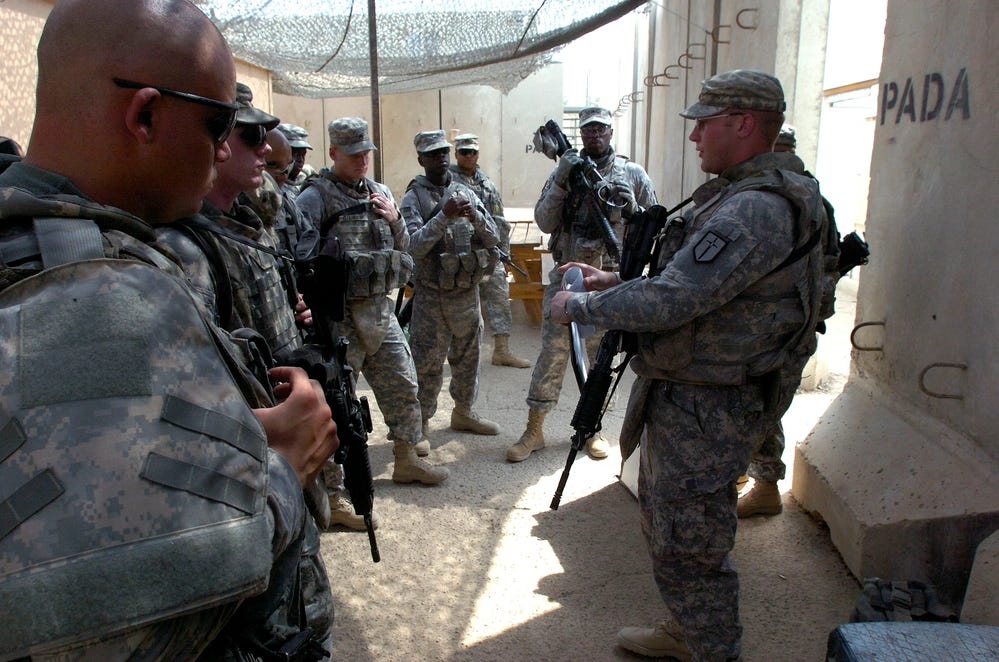
The American military’s genuine competitive advantage is not hardware. It is the way it develops junior officers and NCOs who are trained to act independently and make decisions without waiting for explicit orders. This philosophy is called mission command.13
These young leaders are watching the same battlefield videos as the Ukrainians. A lieutenant who understands what a $400 drone can do to an $8 million Abrams tank does not need to be persuaded that something has changed.14 She needs a system that lets her do something about it.
That system does not support her leaderrship. She can adapt tactics. She cannot rapidly procure materiel. Her request enters a process measured in fiscal years. By the time a solution is delivered, the problem has evolved generations past what she asked for.
The military applies mission command to tactics and refuses to apply it to acquisition. It trains junior leaders to act with initiative, then builds a procurement system that makes that initiative operationally meaningless the moment it involves a new tool. This is not simply a cultural failure. Acquisition authority is centralized by statute, not just by habit, which means reform requires Congress to act, not just the services. Higher command is failing those young people because inertia was baked into the procurement process at a dinner table thirty years ago.
The cost of that failure has become concrete. Drone strikes on U.S. deployed positions during the Iran conflict produced casualties that faster counter-drone procurement could have prevented.15 The damage extends beyond our troops to civilians in allied countries harmed by our failure to innovate in counter-drone technology.
What Would Actually Help
Three reforms would begin to address the structural problem.
Shorter contract terms with mandatory re-competition triggers would restore competitive pressure to an oligopoly that currently faces none. A five-year ceiling on sustainment contracts, with automatic re-competition at each renewal, gives outside suppliers a real chance to enter the market and gives primes a reason to cut costs rather than entrench them.
Discretionary rapid-procurement budgets for theater commanders would give mission command real teeth in the acquisition domain. A lieutenant with a six-figure rapid-procurement authority, subject to after-action audit rather than prior approval, can respond to a threat in the same cycle that threat evolves. The current system cannot.
A policy requiring justification at the component level, with a default to commercial parts wherever the threat environment does not specifically preclude them, would begin to break the vertical integration trap from the inside. Applied systematically, it would erode the captive supplier relationships that keep costs high and innovation slow.
Reform threatens existing contracts, jobs, and congressional relationships. That is why it has not happened. The countries learning fastest from Ukraine are the ones whose survival depends on it. The window is not unlimited.
Other News
I’m pleased to see both our legislators and Governor Kotek calling for a delay to allow greater scrutiny of the PeaceHealth/ApolloMD deal. It’s a step in the right direction.
Disclaimers
In writing my columns, I depend on the representations made in the press. Some of the facts may remain in dispute.
The views expressed herein are those of the author and not necessarily those of the Department of Navy, the Department of Defense, the University of Oregon, or any other entity with which the author is affiliated.
Keep Letters from a Recovering Politician Free
As always, the best thing you can do to support this column is to share it with people who might be interested. I do not have a paid plan because I want folks to be able to access it without worrying about money.
Endnotes
Wikipedia, “Last Supper (defense industry)”; WBUR/On Point, “The Last Supper: How a 1993 Pentagon Dinner Reshaped the Defense Industry” (March 1, 2023).
Wikipedia, “Last Supper (defense industry)”.
Air & Space Forces Magazine, “The Distillation of the Defense Industry” (July 1998).
WBUR/On Point, cited above, note 1.
Washington Post, “How a Dinner Led to a Feeding Frenzy” (July 4, 1997).
F-35 program cost data publicly tracked by the Government Accountability Office; program reached full operational capability in 2023.
On Apple’s manufacturing strategy and IP risk acceptance, see Charles Duhigg and Keith Bradsher, “How the U.S. Lost Out on iPhone Work”, New York Times (January 21, 2012).
UAS Vision, “General Atomics Owner Joins Forbes 400” (January 9, 2020).
Alternet, “The Billionaire Brothers Behind America’s Predator Drones” (April 2013).
CIA, “The Early Evolution of the Predator Drone”, Studies in Intelligence, Vol. 57, No. 1 (2013); National Air and Space Museum, “The Predator, a Drone That Transformed Military Combat”.
On COTS utilization in the Predator program, see Richard Whittle, Predator: The Secret Origins of the Drone Revolution (Henry Holt, 2014).
ADP 6-0, Mission Command: Command and Control of Army Forces (U.S. Army, July 2019).
On FPV drone costs vs. Abrams tank costs, see Military.com, “How Ukraine’s Drone War Is Forcing the U.S. Army to Rewrite Its Battle Doctrine” (October 19, 2025).
Hey Marty,
Compliments on your excellent exposition and case study of vertical integration in military procurement. Ironically, it was accompanied by a heads-up regarding the Peace Health contract and the pending controversy over Oregon's legal authority to review health care transactions notably contracts affecting structural conditions such as cost, quality, equity, and access. I would argue that the greatest problem at the state level--unlike the Feds-- is not the adequacy of statutory authority. It is more the capacity and commitment of the state to work through highly complex proposals in order to take structurally sound actions. We have not made the investment of resources and political leadership necessary to achieve that objective. As you well know, the recent OHSU-Legacy merger proposal raised precisely these issues. In that case, the state HCMO program was overwhelmed by the complexity of the deal. Fortunately, the massive transaction sank on its own even before the state was required to finalize its decisiion. Needless to say, that's hardly a sustainable course of action.
:Larry Kirsch
Portland
Hi Marty -
Many years ago when I was an undergrad at Chico State, I had a professor who started every single lecture by drawing “the umbrella of corporate capitalism” on the board and by reminding us of how Pres. Eisenhower warned about a military-industrial complex overtaking the country. Nothing more to say at this point I guess . . .
Are you still meeting at Provisions South on Th AMs? I wasn’t able to join you before, but I’d put it on my calendar now is it’s still happening.
Thank you for sharing your knowledge with us. It is vital even when it is discouraging. - Debra