
Same Playbook, Different Jersey
McKenzie-Willamette Medical Center and Oregon’s Thin Line of Defense Against Private Equity

Two hospital stories are unfolding in Lane County right now. They look different on the surface, but underneath they follow the same playbook.
For readers joining this series for the first time, here is the background. Lane County is home to two major hospital systems. PeaceHealth, a large nonprofit chain, operates the Sacred Heart hospitals in Eugene and Springfield. McKenzie-Willamette Medical Center, a for-profit hospital in Springfield, competes with it. Over the past few months I have written about how ownership and finance, rather than community need, increasingly drive decisions at both.
In earlier pieces I traced how PeaceHealth reshaped care across the region, and the pattern was financial. Service lines shrank, margins drove the decisions, and the public learned the reasoning only after the fact. PeaceHealth’s relationship with Lifepoint Health, a hospital operator backed by the private-equity firm Apollo Global Management, showed how corporate and investment layers come to sit between patients and the people who actually make the calls.
Now McKenzie-Willamette Medical Center is moving in what looks like the opposite direction. Quorum Health, the hospital’s for-profit owner, signed a deal in May 2026 to convert the hospital into a nonprofit named Healthside Partners.[1] The promise sounds appealing. The conversion would bring tax savings near $13 million a year. It would also make the hospital eligible for 340B pricing, a federal program that lets qualifying hospitals buy outpatient drugs at a steep discount, worth roughly $11 million a year. Quorum has also pledged $300 million in capital investment across its facilities over three years.[2]
The problem is that nobody can say who actually stands behind the new nonprofit. Reporters could not find where Healthside Partners is based, who funds it, or whether the group already owns other hospitals, and Healthside did not respond to requests for comment.[3] At the time of writing, OHA declined even to say whether their application for the transfer of ownership was complete. A nonprofit label tells you nothing about who controls the buildings, the cash, or the leases underneath.
From a patient’s point of view, both stories share one defining trait. Boardrooms far from Eugene make the decisions, and local emergency rooms, maternity wards, and primary-care clinics live with the results.
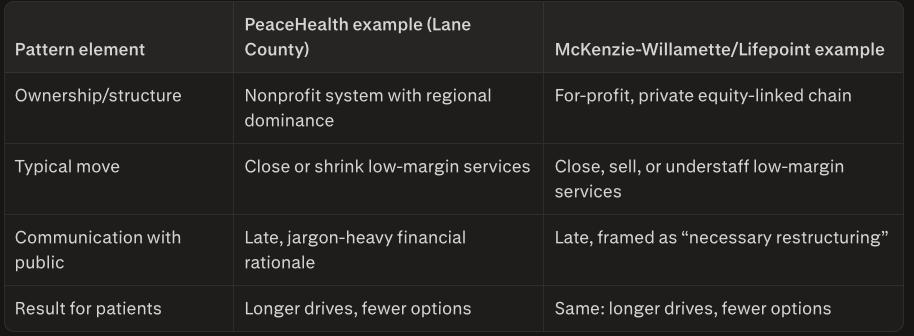
What the two cases share
Beneath the differences, four patterns repeat in both stories.
First, money leads the way, and regional planning does not. PeaceHealth’s service closures and Quorum’s conversion both responded to payer mix, meaning the balance of patients with private insurance versus public coverage, along with thin margins and investment math. Neither decision grew from any deliberate plan for how Lane County should deliver care.
Second, ownership hides from view. In the PeaceHealth and Lifepoint arrangement, layers of corporate and private-equity ownership blur who really controls the assets. In the Quorum deal, Healthside’s backers and the underlying real-estate terms remain out of public sight.
Third, the risk falls hardest on patients with public coverage. Quorum frames the conversion as a response to looming federal Medicaid cuts, yet Medicaid and Medicare patients are the ones who carry the downside when nearby services thin out or wait times grow. McKenzie-Willamette already ranks among Oregon’s most profitable hospitals while reporting very little charity care, which makes its commitment to those patients an open question.[4]
Fourth, the state shows up only after the deal is already built. Oregon reviews transactions that have been fully negotiated, and the agency does so with legal tools never designed to police private-equity-style finance.
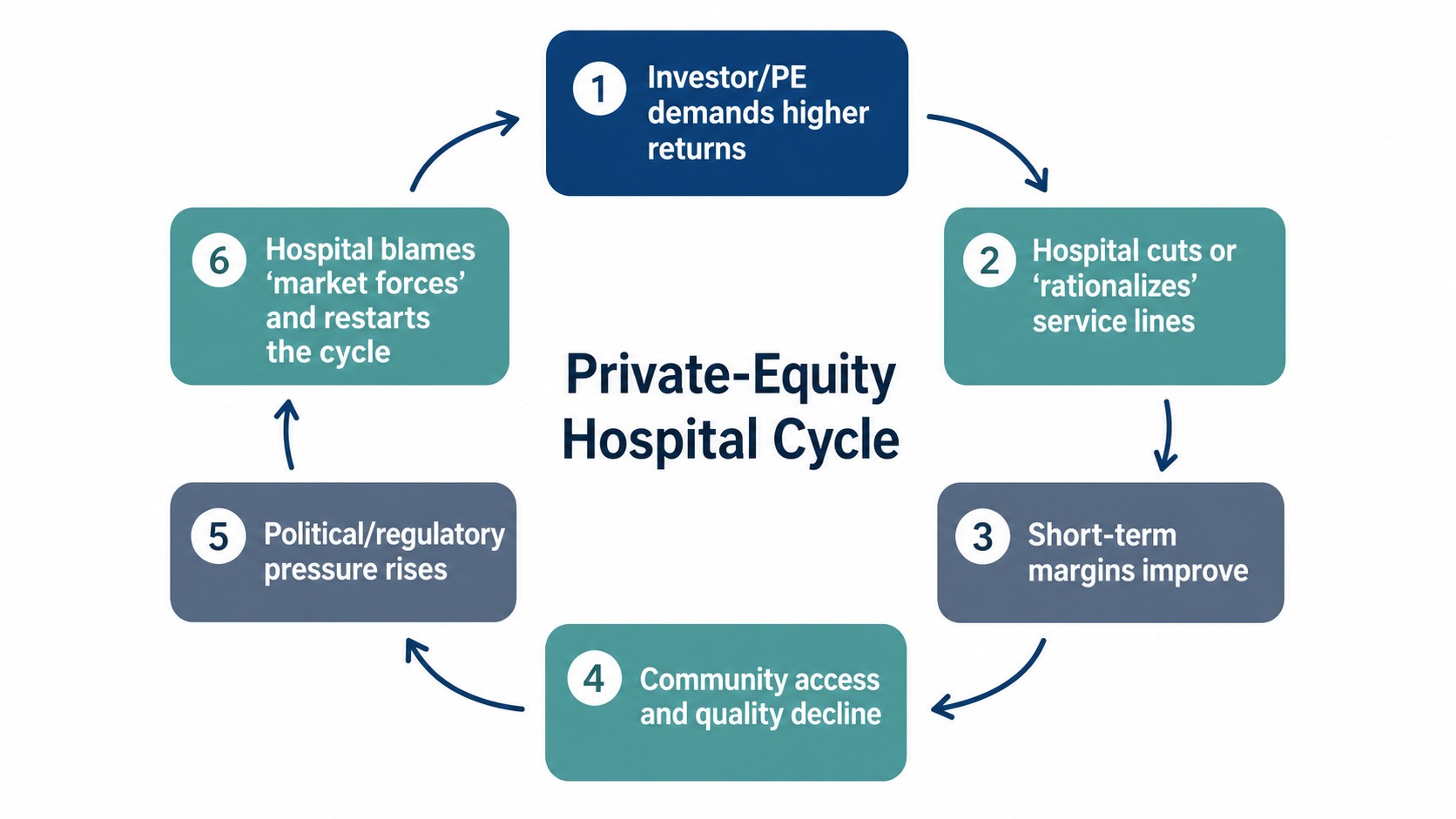
Why this deal goes to Market Oversight, not Certificate of Need
Oregon holds two separate regulatory levers, and the McKenzie-Willamette deal triggers a specific one. Understanding the difference explains what the state can and cannot do here.
The first lever is Certificate of Need, governed by ORS 442.315, which regulates growth. The law asks whether a region actually needs new capacity, such as a new hospital, a new nursing facility, or an increase of more than ten beds or ten percent. Its purpose is to control costs and prevent duplication of services.[5] This is the process PeaceHealth and Lifepoint must follow when they want to build new facilities.
The Quorum conversion, by contrast, adds no beds and no buildings. It changes who owns and controls an existing hospital, which routes the review to the second lever, the Health Care Market Oversight program, or HCMO.[6] That program covers mergers, acquisitions, affiliations, sales, and leases that shift control of a health care entity. The legal question shifts along with the tool. Certificate of Need asks whether the region needs new capacity, while Market Oversight asks whether a change in control would harm access, cost, quality, or equity across Oregon.[7]
Put another way, Oregon built one tool for bricks and mortar and a newer tool for consolidation and financial engineering. The McKenzie-Willamette deal falls squarely into the second category.
What Market Oversight lets the state do
This distinction matters because HCMO carries real enforcement power, provided the agency chooses to use it. The legislature gave the Oregon Health Authority the authority to block a transaction outright or to approve it with conditions attached.[8] Filers must give 180 days notice and explain how their deal will slow cost growth, widen access, and improve quality and equity.[9] Since the program began in 2022, the agency has reviewed twenty deals and attached conditions to five of them.[10]
So the answer to the central question is yes. The state holds the authority to demand community benefit, at least on paper. Whether the agency actually uses that authority is a separate question of politics and staffing.
Because the deal skips Certificate of Need entirely, Market Oversight is the one formal moment when Oregon can insist that this conversion genuinely helps Lane County. Several reasonable conditions follow directly from the statute’s access and equity standards. The state could require full disclosure of who owns the real estate and of any lease or management agreements with related for-profit entities. It could set minimum levels of Medicaid and Medicare participation and require a clear charity-care policy, which matters given the hospital’s thin charity record. It could protect emergency, maternity, and behavioral health services for a defined number of years. And it could require community seats on the new nonprofit board along with a public, enforceable community-benefit plan.
None of these conditions are extras. Each one ties directly to HCMO’s mandate to prevent harm to access and equity.
Even so, the process has a structural limit worth naming. McKenzie-Willamette remains under a for-profit owner until the deal closes, and a for-profit owner carries an inherently lower duty to the community. The result is a genuine bind. If HCMO requires too much, Quorum retains the option to walk away and start cutting unprofitable services on its own terms. If HCMO requires too little, a nominally nonprofit hospital becomes little more than a cash source for its corporate partner.
The bigger picture
PeaceHealth and McKenzie-Willamette show the same truth from two different angles. Capital flows shape who gets care, and when, and where. The legal form changes from one deal to the next, whether private-equity partnership, sale-leaseback, or nonprofit conversion, but the effect on patients stays remarkably consistent.
Oregon’s defenses are still catching up to this reality. Certificate of Need was built for an earlier era of hospital expansion, while Market Oversight is younger and broader in scope. The newer program will matter only if the Health Authority decides to act.
The public comment process is your opening. Clinicians, patients, and local officials should file comments in the McKenzie-Willamette review and press for conditions that carry real enforcement. A new jersey is not the same thing as a community benefit, and the state has the authority to ask for more.
Emailing hcmo.info@oha.oregon.gov is the simplest route, just reference the Quorum Health / Healthside Partners / McKenzie-Willamette transaction.
Disclaimers
In writing my columns, I depend on the representations made in the press. Some of the facts may remain in dispute.
The views expressed herein are those of the author and not necessarily those of the Department of Navy, the Department of Defense, the University of Oregon, or any other entity with which the author is affiliated. No government time or resources were used in the writing.
Keep Letters from a Recovering Politician Free
As always, the best thing you can do to support this column is to share it with people who might be interested. I do not have a paid plan because I want folks to be able to access it without worrying about money.
Footnotes
[1] Quorum Health to transition to nonprofit through deal with Healthside Partners, Healthcare Dive; Becker’s Hospital Review.
[2] McKenzie-Willamette poised for nonprofit ownership as Medicaid cuts loom, Lookout Eugene-Springfield.
[3] Same Lookout Eugene-Springfield report, on Healthside’s undisclosed backers and lack of comment.
[4] Oregon’s Most Profitable Hospital Has No Charity Care, Favors Private Insurers, The Lund Report.
[5] ORS 442.315, Certificate of Need, Oregon Public Law; OHA Certificate of Need.
[6] OHA Health Care Market Oversight, program page.
[7] HCMO review criteria for cost, access, quality, and equity, OHA HCMO FAQ.
[8] Authority to block or impose conditions, Center on Health Insurance Reforms, Georgetown; Milbank Memorial Fund.
[9] 180-day notice and filing purpose, OHA HCMO FAQ.
[10] Review and conditions record since 2022, Center on Health Insurance Reforms, Georgetown.
This information is so important and thank you for delving into it. I hope you will continue following this issue and reporting to us about it!