
Closing Eugene’s Climate Gap
Three Strategies That Could Actually Work

Eugene set ambitious climate goals in 2014. The Climate Recovery Ordinance committed the city to cutting fossil fuel use 50% below 2010 levels by 2030.[1] Twelve years later, our community has only reached an 11% reduction.
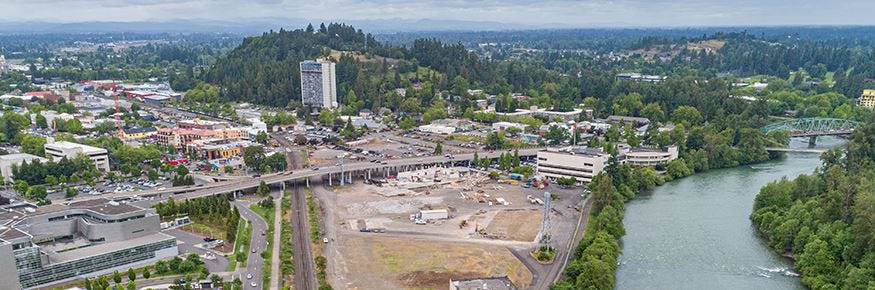
The gap between aspiration and achievement has identifiable causes and available solutions. Three of those solutions are within reach right now, if the city’s three major public institutions work together on them.
The Eugene Water and Electric Board (EWEB) has delivered, already exceeding its own 2030 emissions target, achieving a 55% reduction against its 50% goal.[2] The broader community has not delivered, because achieving the goal requires tackling how we use energy in our buildings and how we move around the city.
Strategy 1: Build the Charging Network That Makes EVs Work for Everyone
Transportation accounts for 54% of Eugene’s community carbon output.[3] Widespread EV adoption could reduce Eugene’s total emissions by nearly 40% as soon as 2040.[4] Oregon’s new vehicle standards require 100% of new passenger cars sold to be zero-emission by 2035, but the infrastructure to support them has lagged.
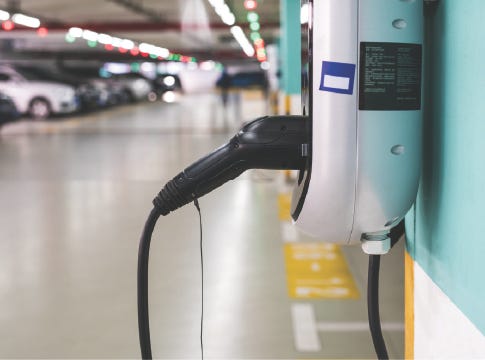
Right now, convenient charging is largely limited to people who own single-family homes and can plug in overnight. That leaves out renters, who make up roughly half of Eugene’s households. It also leaves out the workers and students who park at transit stations, commercial lots, and apartment complexes.
Each community entity has a role. EWEB could increase access by installing and managing charging infrastructure at key locations. The city could streamline permitting for chargers at apartment buildings and commercial properties. Lane Transit District (LTD) could electrify its park-and-ride facilities so commuters can charge while they ride the bus to work.
What It Costs
Chargers come in three levels - 1) a standard 110 volt wall plug, sometimes called a trickle charger, 2) a 240 volt, like a dryer plug, which generally gets to a full charge overnight, and 3) a DC fast charger, which usually takes 15 minutes to 1 hour for a charge. A meaningful starter network of 50 Level 2 stations and 10 DC fast chargers would cost between $1.5 and $2.5 million.[5] The service need not be free, but it should be less than the extortionate rates charged at Level 3 chargers. The real advantage is that every EV charged on EWEB’s grid runs on electricity that is approximately 90% carbon-free.[7] In most American cities, switching to an EV still means burning natural gas at a power plant somewhere. In Eugene, it means running on hydropower and wind.
Strategy 2: Scale Up Building Electrification from Hundreds to Thousands
In 2025, EWEB completed 193 structure electrification projects through its rebate programs, which helped customers save more than 14 million kWh of electricity.[8] That is a solid foundation, but far too slow to close the climate gap. At that rate, it would take decades to electrify a meaningful share of Eugene’s building stock.
The component parts for acceleration already exist. Oregon’s Heat Pump Purchase Program offers rebates up to $2,000 per installation, funded through the state’s $197 million federal Climate Pollution Reduction Grant.[9] Energy Trust of Oregon adds another $250 to $4,000 in rebates, depending on the system and customer eligibility.[10] Statewide, 712 heat pump rebates were issued in just the program’s first year.[11]
Internationally, cities that combined utility incentives with building code requirements saw the fastest adoption rates. Building-sector policies in countries participating in one global initiative cut urban emissions by a full fifth since 2015.[12] Those gains outperformed reductions from cleaner electricity grids over the same period. Voluntary programs help. But requirements move the needle significantly.
What It Costs
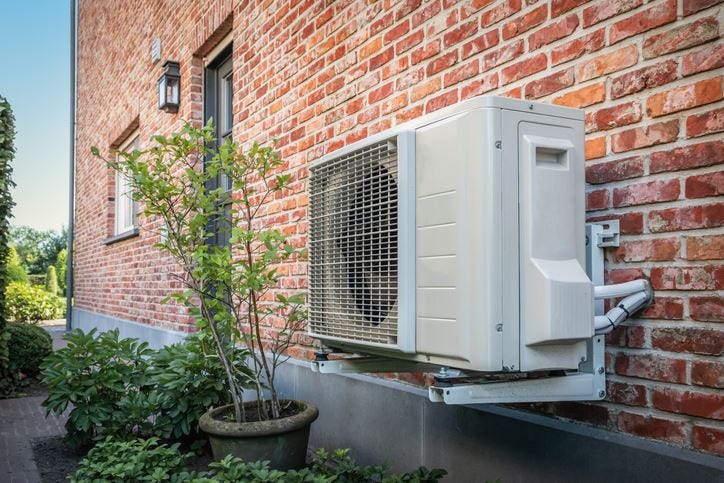
Scaling to 1,000 heat pump installations per year would require $8–$12 million in total project costs, compared with an EWEB annual budget of almost half a billion. Federal and state rebates currently cover 30–50% of that amount, depending on household income and system type. EWEB’s own rebate programs add additional support. The net local investment, which could be shared between EWEB rate structures and city incentive programs, would run $4–$8 million annually. The city’s role is built on the new state mandate for new construction to have heat pumps, rather than standard air conditioning. The city should push to close the loophole left by not requiring air conditioning; it should clarify that new construction must also use heat pumps for heating. Let EWEB and the state handle the financing side. Eugene needs to build 26,000 housing units over the next 20 years. Every unit should have a heat pump.[13]
Strategy 3: Coordinate Land Use and Transit to Make Driving Optional
Americans love their cars, but they’ll use transit if it’s convenient. Research consistently shows that transit-oriented development (TOD) increases transit use by 20–40% and reduces household driving by similar amounts.[14] Portland’s Metro has supported nearly 100 transit-oriented projects that generate approximately 2 million transit rides per year.[15] Promoting transit requires cooperation between EWEB, LTD, and the City.
Our city has the ingredients. LTD’s EmX bus rapid transit corridors already provide the spine. EWEB’s electrification programs can target buildings along those corridors. What is missing is the land use piece. State law now requires a minimum of 25 housing units per acre in “Climate-Friendly Areas” (CFAs) served by frequent transit. However, there’s nothing stopping Eugene from requiring more. Further, the draft CFA plan currently under consideration applies only to downtown and the part of Coburg Road closest to the Willamette River. Eugene will still allow low-density development in areas that should be the highest-ridership zones in the transit system, those along bus rapid transit (EmX) routes. We can do better.
A formal joint agreement would work like this. The city upzones two or three corridors adjacent to EmX lines for higher-density, mixed-use development. LTD commits to preserving its 10 minute EmX frequency on those corridors to make transit genuinely competitive with driving. EWEB targets its electrification incentives and EV car-share stations at those same corridors, creating neighborhoods where a household can realistically live without a second car.
What It Costs
The planning and zoning changes cost $2–$5 million. Federal Transit Administration planning grants can offset a significant portion. The real savings come downstream. Local governments can reduce up to 25% of infrastructure costs for water, sewage, and roads through compact infill development rather than sprawl.[16] The development itself is largely private investment, guided by public decisions about where density belongs.
The Funding Landscape
Oregon has access to substantial federal climate funding. The state’s $197 million Climate Pollution Reduction Grant has already reached 32 of 36 counties.[17] That money is specifically earmarked for the kinds of projects described here. Heat pump rebates, EV infrastructure, and transit-adjacent development all qualify.
The real question is how long federal funding will last. The current administration has signaled hostility toward climate programs, and Inflation Reduction Act tax credits face an uncertain future. That makes the case for moving quickly even stronger. The money is available today. Waiting is the riskiest strategy of all.
On the local side, EWEB’s rate structure already supports electrification programs. The city has urban renewal district funding that can be directed toward infrastructure in Transit-Oriented Development corridors. LTD’s service improvements, planned for Fall 2026, create a natural coordination point.
What This Adds Up To
None of these require Eugene to invent something new. Each one uses tools that other cities have already proven to work. The difference between cities that are closing their climate gaps and cities that are falling further behind is not ambition. It is coordination.
EWEB has already shown what a focused institution can accomplish. It exceeded its 2030 goal years ahead of schedule. The question now is whether the city and LTD can match that focus on the pieces only they control, specifically building codes, zoning, and transit frequency. The answer depends less on money than on whether three public boards can agree to pull in the same direction.
Eugene set the right goals twelve years ago. The tools to meet them are sitting on the table. We just have to be willing to use them.
Other Carbon Saving Options
I don’t mean to give short shrift to other climate-friendly options. In my house, we eliminated the need for another car by getting an e-bike with assistance from an EWEB program. It’s now my primary transportation around town. Of course, not everyone can or wants to ride a bicycle. The possibility of EV autonomous cabs is on the horizon. While they’re not currently any cheaper than a standard taxi or ride-share, they have the potential to drop the cost of trips by about 60%.
Disclaimers
In writing my columns, I depend on the representations made in the press. Some of the facts may remain in dispute.
The views expressed herein are those of the author and not necessarily those of the Department of Navy, the Department of Defense, the University of Oregon, or any other entity with which the author is affiliated. No government time or resources were used in the writing.
Keep Letters from a Recovering Politician Free
As always, the best thing you can do to support this column is to share it with people who might be interested. I do not have a paid plan because I want folks to be able to access it without worrying about money. Should you wish to contribute, you can do it with one of the first two buttons below or by signing up for a subscription through Substack. As of yet, I don’t have any plans for a paid tier, so it’s really just another way of leaving me a tip. I’ve recently starting reinvesting a part of these contributions to increasing the reach of the publication.
Endnotes
[1]City of Eugene, “Fossil Fuel and Greenhouse Gas Reduction Forecast,” presented to Eugene City Council, 2026. The Climate Recovery Ordinance (2014) set a target of reducing community fossil fuel use 50% below 2010 levels by 2030.
[2]EWEB, “Climate Policy,” eweb.org/environment-and-climate/climate-guidebook/climate-policy. EWEB reported aggregate emissions reductions of 55% compared to 2010 baseline.
[3]City of Eugene, “Electric Vehicles (EVs),” eugene-or.gov/4664/Electric-Vehicles-EVs. Transportation accounts for 54% of community carbon emissions.
[4]EWEB, “Preparing for Expected Surge in Electric Vehicles,” eweb.org. EWEB calculates that broad EV adoption could cut Eugene’s total carbon emissions by nearly 40% by 2040.
[5]Recharged.com, “EV Charging Station Installation Cost 2025 Guide.” Level 2 commercial installations range from $3,000–$13,000 per port. DC fast charging ranges from $70,000–$200,000 per port installed.
[6] Eliminated in editing
[7]EWEB, “Managed Electric Vehicle Charging Explained,” eweb.org. EWEB’s electricity is approximately 90% carbon-free.
[8]EWEB, “2025 Residential Program Summary.” 193 building electrification projects completed in 2025. Energy efficiency projects saved more than 14 million kWh and approximately 1,000 MT of CO2.
[9]Oregon Department of Energy, “Oregon Heat Pump Purchase Program,” oregon.gov/energy. Funded through Oregon’s $197 million federal Climate Pollution Reduction Grant. Rebates up to $2,000 per installation.
[10]Energy Trust of Oregon, “Heating Solutions Incentives,” energytrust.org. Rebates range from $250 to $4,000 depending on system type and customer eligibility.
[11]OPB, “One year in, a $200M climate grant has funded work in 32 of Oregon’s 36 counties,” December 2, 2025. Through ODOE, 712 heat pump rebates had been issued statewide.
[12]C40 Cities, “2025 in action: cities and nations driving climate progress together.” Building-sector policies in CHAMP countries cut urban emissions by one-fifth since 2015.
[13]Lookout Eugene-Springfield, “Eugene mayor lays out challenges for 2026,” January 12, 2026. Eugene needs 26,273 additional housing units over the next 20 years.
[14]Transportation for America, “Unlocking the benefits of transit-oriented development,” June 13, 2025. TOD may increase transit use by 20–40% and reduce household driving by similar amounts.
[15]Oregon Metro, “Transit-Oriented Development Program,” oregonmetro.gov. Nearly 100 projects supported, generating approximately 2 million annual transit rides.
[16]John L. Renne and Jan S. Wells, "Transit-Oriented Development: Developing a Strategy to Measure Success," NCHRP Research Results Digest 294 (Transportation Research Board, February 2005), trb.org/publications/nchrp/nchrp_rrd_294.pdf.
This is a very well thought out plan for reaching Eugene's energy goals. My expertise is in solar and EVs, having installed solar in 2002 and bought my first EV the same year. I know what it's like to use an EV with a 100 mile range and very few chargers. We made it work back in the day. Today, there are millions of EVs with a range exceeding 300 miles, and charging infrastructure is abundant, but could be better. For those with the ability to use the North American Charging Standard (NACS), the Tesla chargers are available for fast charging. For most, a simple 20 minute charging session is all you need for a week of driving.
I'm most excited about the coming cybercab. It's the fully-autonomous two-seat car being tested in Austin and San Francisco right now with an anticipated release by 4th quarter this year. The car is very cheap to build, about $25,000, and since there is no driver, the cost per mile for door-to-door service is super cheap, easily half that of Uber. Most folks could easily use this and just not own a car. I predict that for younger people, this will replace the desire to get your license at 16 and buy a car as soon as possible. And older folks, who might be dangerous behind the wheel as their faculties diminish, will be able to get anywhere easily and with minimal cost.
Most importantly, never buy a new gas car again, only EVs going forward.
I don't see how those numbers ( I assume generated by City Staff) match reality when Eugene continues to expand its urban growth boundary by thousands of acres every decade along with building out street, water and sewage infrastructure to foster the new urban growth boundaries, increasingly building new giant student housing complexes, building 5 story parking structures made out of concrete and steel, and more giant 100 million $$$ sports complexes? Frankly, based on 30 plus years of working on increasing ecological protections and reducing ecological footprints of Eugene and Lane County, these numbers strike me as just purely greenwashing Bull Crap. The only way Eugene and human civilizations will reduce our emissions, ecological foot prints and perhaps prevent biospheric collapse is through "de-growth", not more cancerous growth upon collapsing natural ecosystems. Sorry, I can't seem to buy into the Hopium offered. via Shannon Wilson. League of Wilderness Defenders since 1997 thereof.